

CTI 2598-8 8-Point AC Output Module
2598-8 8-Point AC Output Module
The 2598-8 provides 8 11-240 VAC outputs from the CTI 2500 Series® or Simatic® 505 I/O base. The solid-state output circuits can be used to switch on or off external devices such as pilot lamps, motor starters, or solenoids.
Features
2598-8 replaces Siemens® 505-4608. 4808
Individually fused sourcing outputs
Isolation in groups of 2
Wide 11-240 VAC output range
2.0 Amps per output
Description
The 2598 8/16-Point AC Discrete Output Module
provides eight outputs isolated in groups of 2 from
CTI 2500 Series® or Simatic® 505 I/O bases. The
module utilizes solid-state output circuits to switch on
or off external devices such as pilot lamps, motor
starters, or solenoids. The 2598-8 is designed to
switch externally supplied 11 to 240 VAC. The internal
logic signals are isolated from the external outputs to
2100 VDC.
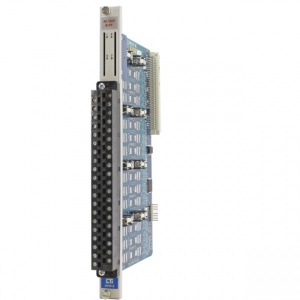
2598-8
Features
• 8 AC output points
• Replaces Siemens® 505-4608. and -4808.
• 3000 VDC group-to-group isolation
• 2100 VDC channel-to-backplane isolation
• Isolation in groups of two
• Wide 11-240 VAC output range
• 2.0 Amps per output
• 16 Amps total module output
• Individually fused outputs
• Sourcing outputs
• Single-wide module
2598-8 8-Point
AC Discrete Output Module
Channel Configuration Explanation
The 2598-8 was designed using a PCB that could also perform as a 16 or 32pt module. Hence, the PCB printing for
channels do not line up with actual 2598-8 channels. See chart below for the proper correlation of channels. For exam
ple, if the module reported channel 4 was blown, then the user would replace the fuse marked ‘CH 10’ on
the PCB.
Grouping Configuration
The 2598-8 is shipped to allow two channels to be grouped and share a common field user power, thereby allowing a
different user power supply voltage to be used by each grouping. Jumpers J2. J4. J6. and J8 come
set in the “8 common” selection from the factory and should not be altered for proper module operaton. This setting al
lows for 2 points per common operation.
For example, Channels 1-2 will share a common user power and Channels 3-4 will share another common user power.
In this example each group of two channels is isolated from the other group of two channels. Be-cause each group of
two is isolated, the user may also change the supply voltage for each group. So, in this example, Chan- nels 1-2 could
be 240VAC outputs and Channels 3-4 could be 120VAC outputs.