

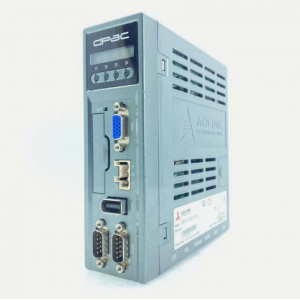
ADLINK DPAC-3020-11(G) Embedded PC Automation Controller
ADLINK DPAC-3020-11(G) Embedded PC Automation Controller
Product Overview
The ADLINK DPAC-3020-11(G) is a compact, fanless Distributed Programmable Automation Controller (DPAC) engineered for demanding industrial automation, machine vision, distributed motion control, and real-time process monitoring. Powered by an ultra-low-power Intel Celeron M processor, it combines the deterministic processing power of a PC-based controller with the ruggedness required for harsh factory-floor environments.
Featuring integrated high-speed motion control (HSL/Motionnet) interfaces, industrial Ethernet, CompactFlash storage, and fanless passive cooling, the DPAC-3020-11(G) provides an all-in-one solution for automated inspection equipment, semiconductor manufacturing lines, and robotic control systems.
Technical Parameter List
| Feature / Parameter | Specification Details |
| Model | DPAC-3020-11(G) |
| Processor | Intel Celeron M 1.0 GHz (Ultra-Low Voltage) |
| System Memory | Onboard DDR SDRAM (up to 1 GB) |
| Storage Interface | 1x Type I/II CompactFlash (CF) Card Slot |
| Display Controller | Integrated Intel Graphics Engine with CRT/VGA output |
| Network Interfaces | 2x 10/100 Mbps Fast Ethernet (RJ-45) |
| Motion & I/O Control | Integrated High-Speed Local Bus (HSL) / Motionnet Master Controller |
| Serial Ports | 2x RS-232/422/485 serial ports (DB-9) |
| USB Interfaces | 2x USB 2.0 High-Speed ports |
| Digital I/O | Onboard Isolated Digital Input / Digital Output channels |
| Power Input | +24 VDC (±5%) regulated industrial power supply |
| Power Consumption | Approx. 25W – 35W (configuration dependent) |
| Cooling System | Fanless design with heavy-duty extruded aluminum heatsink chassis |
| Status Display | Built-in 4-digit LED display and programmable status indicators |
Product Features & Core Advantages
Fanless & Cableless Architecture: Eliminates moving parts and internal ribbon cable degradation, drastically increasing Mean Time Between Failures (MTBF).
Real-Time Motion Control Integration: Onboard HSL / Motionnet master module enables high-speed, synchronized multi-axis servo control and distributed I/O acquisition.
Rugged Industrial Design: Resists severe vibration and mechanical shock while operating reliably under continuous high-duty factory cycles.
Direct DIN-Rail Mounting: Streamlines control cabinet installation alongside traditional PLCs, motor drives, and circuit breakers.
Broad OS Support: Optimized for real-time operating systems including Windows CE, Windows XP Embedded, and Linux automation stacks.
Model Classification & Series Naming
The ADLINK DPAC-3000 series utilizes a structured model naming convention based on processor tier, motion/I/O interface, and environmental/lead-free certification:
| Model Variant | Description & Configuration |
| DPAC-3020-11(G) | Intel Celeron M 1.0 GHz, HSL/Motionnet Master, Lead-Free (RoHS “G” version) |
| DPAC-3020-11 | Standard Intel Celeron M 1.0 GHz base model with HSL bus |
| DPAC-3010-11(G) | Base CPU automation controller without integrated high-speed motion daughterboard |
| DPAC-3020-13(G) | Higher-performance Intel Pentium M processor configuration |
Environmental Tolerance Conditions
| Parameter | Operational Limit | Storage Limit |
| Ambient Temperature | 0°C to 50°C (32°F to 122°F) | -20°C to 80°C (-4°F to 176°F) |
| Relative Humidity | 10% to 90% (non-condensing) | 5% to 95% (non-condensing) |
| Vibration Resistance | 5 Grms, 5–500 Hz, 3 axes (with CF card) | 5 Grms, 5–500 Hz, 3 axes |
| Shock Resistance | 50 G peak acceleration, 11 ms duration | 100 G peak acceleration |
| EMC / Certifications | CE Class A, FCC Class A certified | — |
Installation Method
1.Mounting Preparation:Ensure panel layout provides adequate thermal clearance。
Verify that the cabinet DIN-rail (35 mm) is securely anchored. Allow at least 50 mm of ventilation clearance above and below the fanless heatsink fins for natural thermal convection.
2.DIN-Rail Attachment:Tool-less mechanical locking mechanism。
Hook the top groove of the DPAC-3020 mounting clip onto the top edge of the 35 mm DIN-rail. Push the bottom of the controller firmly toward the rail until the spring-loaded latch snaps into position.
3.Grounding & Power Wiring:Prevent ground loops and electrical interference。
Attach a dedicated chassis ground wire to the functional earth (FE) terminal. Wire the +24 VDC industrial power source to the 3-pin removable terminal block, double-checking polarity before energizing.
4.Fieldbus & Bus Cabling:High-speed signal connection setup。
Connect the RJ-45 LAN cables for network control, and secure the HSL / Motionnet shield cables to the DB-9/RJ-45 bus ports to ensure high-noise immunity across distributed drives.
DPAC-3020-11
Operating Instructions
CF Card Insertion: Prior to applying power, insert the CompactFlash card containing the operating system and target software into the front CF slot until locked.
System Power-Up: Apply +24 VDC power. Observe the front panel 4-digit status LED display to verify successful boot diagnostic sequences.
Network Configuration: Assign static IP addresses to the Fast Ethernet controllers to match your plant subnet setup.
Motion Bus Initialization: Run the ADLINK MotionCreator or HSL software utility to scan and map all connected distributed servo drivers and remote I/O modules.
Periodic Maintenance: Periodically inspect the heatsink fins to ensure they remain clear of dust build-up. Always disconnect +24 VDC power before removing or swapping the CompactFlash card.