

Motorola MVME374 Intelligent VMEbus Ethernet Controller Board
Motorola MVME374 | Intelligent VMEbus Ethernet Controller Board
The Motorola MVME374 is a high-performance, intelligent Ethernet controller board designed for the VMEbus (IEEE 1014) architecture.
It functions as a dedicated communications processor, offloading network protocol management from the main system CPU to improve overall real-time system throughput.
By integrating a dedicated microprocessor and shared onboard memory, the MVME374 provides a stable and efficient gateway for VME-based systems to connect to local area networks (LAN).
Technical Parameter Table
| Parameter | Specification |
| Microprocessor | Motorola MC68020 (16 MHz or 25 MHz versions) |
| Coprocessor | MC68881 or MC68882 Floating-Point (Optional) |
| Onboard RAM | 1 MB to 8 MB Shared Dynamic RAM (DRAM) |
| Bus Interface | VMEbus (A32/D32 Master/Slave compatibility) |
| Ethernet Interface | 15-pin AUI (Attachment Unit Interface) |
| Network Protocols | TCP/IP, UDP, DECnet, and OSI support (RTOS dependent) |
| Onboard Firmware | MVME374BUG Debug Monitor / BIOS |
| Front Panel I/O | Reset Button, Abort Button, Status LEDs (Run/Fail) |
Product Advantages and Features
Intelligent Processing: Features its own 68K series MPU, allowing it to handle complex Ethernet framing and protocol stacks without taxing the system’s primary processor.
Shared Memory Architecture: Onboard DRAM is accessible by both the local processor and the VMEbus, facilitating high-speed data exchange via DMA (Direct Memory Access).
VMEbus Standard Compliance: Fully compatible with the Eurocard format, making it easy to integrate into existing VME racks from Motorola, Emerson, or other manufacturers.
Field-Proven Reliability: Designed for long-lifecycle industrial and military applications where deterministic communication is critical.
Diagnostic Tools: The integrated 374Bug firmware allows for extensive local and remote diagnostics, simplifying system troubleshooting.
Application Cases
Distributed Control Systems (DCS): Acts as the primary communication link for industrial plants requiring synchronized data exchange between multiple VME racks.
Steel Works & Heavy Manufacturing: High-reliability networking in environments with high electromagnetic interference.
Shipboard Control Systems: Used in maritime automation for engine room monitoring and navigation data distribution.
Legacy System Support: Serving as a vital replacement part for aging Motorola 68K-based industrial workstations and servers.
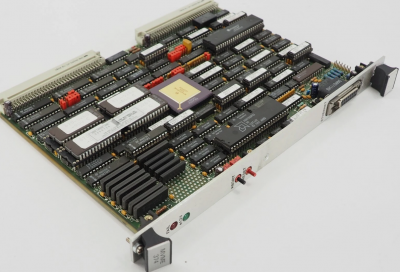
MVME374
Other Models in the Same Series
MVME374-1: The standard revised version featuring enhanced memory options.
MVME376: A high-performance successor with advanced Ethernet controller ASICs.
MVME147: A full single-board computer that often includes integrated Ethernet similar to the 374’s logic.
MVME712B: Transition module used to provide physical SCSI and Ethernet ports for the backplane.
Installation and Maintenance
Pre-Installation: Check jumper headers (such as J1 for software-readable settings) to match your system’s VMEbus memory map.
ESD Protection: Always wear an anti-static wrist strap. The MC68020 and BIOS chips are highly sensitive to static discharge.
Mounting: Ensure the board is properly aligned with the VME P1 and P2 connectors. Use the front-panel ejector handles to seat the board firmly before tightening the retention screws.
Maintenance: Monitor the “Fail” LED during boot-up. A persistent red LED typically indicates a self-test failure in the onboard RAM or BIOS.
Cleaning: Periodically inspect the 15-pin AUI port for dust; use compressed air if necessary to ensure a clean connection to the transceiver.
Unique Product Description
The Motorola MVME374 is more than just a network card; it is a dedicated “communications officer” for the VMEbus.
While modern Ethernet controllers are often integrated into a single chip, the MVME374’s discrete design with a dedicated 68020 processor ensures that even under heavy network loads
your core industrial processes remain uninterrupted. It remains a cornerstone for engineers maintaining robust, time-tested infrastructure that demands absolute reliability over raw speed.