

SEL SEL-401 Protection, Automation, and Control Merging Unit
SEL-401
Protection, Automation, and Control Merging Unit
Apply the SEL-401 for substations with IEC 61850-9-2 or IEC 61869-9 Sampled Values (SV) systems.
Sample analog data, such as currents and voltages, then publish the data to a fiber-based Ethernet network for use in other devices, such as compliant SEL-400 series relays.
The SEL-401 publishes SV data to the process bus network and also provides local protection. Use the built-in phase-overcurrent and breaker failure protection to provide backup in case of communications system failures.
SV Process Bus Implementation—Place the SEL-401 out in the yard right next to primary equipment.
The SEL-401 digitizes analog signals from primary equipment and then transmits them to the control house via a fiber-based Ethernet network.
It can publish as many as seven outgoing data streams of IEC 61850-9-2 or IEC 61869-9 SV data to any relays that subscribe to SV. The merging unit can synchronize the data using the IEEE 1588 Precision Time Protocol Version 2 (PTPv2) or an IRIG-B time input.
Improve system availability in SV applications with the Parallel Redundancy Protocol (PRP), the High-availability Seamless Redundancy (HSR) protocol, or seamless failover using a five-port Ethernet card.
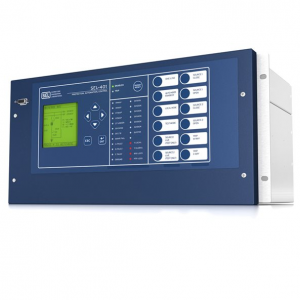
SEL-401
Integrated Protection—Provide local breaker failure and phase overcurrent protection during a loss of the precise time signal or communication to a main substation relay.
The SEL-401 uses high-speed (5/8-cycle) open-pole detection logic to reduce coordination times for critical breaker failure applications.
Sequential Events Recorder (SER)—Record the last 1.000 entries, including setting changes, when the merging unit turns on, and selectable logic element operations.
Dual-Breaker Schemes—Accommodate two sets of three-phase currents and two sets of three-phase voltages to support substations with dual-breaker schemes.
You can combine currents within the merging unit from two sets of CTs for protection functions but keep them separately available for monitoring and station integration applications.
Oscillography—Record voltages, currents, and internal logic points at up to an 8 kHz sampling rate. Phasor and harmonic analysis features allow the investigation of merging unit and system performance.
Flexible Communications Options—Use small form-factor pluggable (SFP) transceivers on designated process bus, station bus, and engineering access ports in the five-port Ethernet card.
Choose between single- and multimode communications options for increased flexibility.
All ports support 100 Mbps SFP transceivers, and process bus ports also support 1 Gbps SFP transceivers.
Rack- or panel-mount, horizontal and vertical hardware packages.
Ethernet connection options for primary and standby connections.
10/100BASE-T
100BASE-FX
Five-port Ethernet card supporting fiber-optic SFP transceivers and 100 Mbps or 1 Gbps data transfer rates.
One or two additional I/O boards with standard, high-interrupting or high-speed/high-interrupting outputs.
User-configurable labels for operator controls and target LEDs.
Conformal coating protects equipment from harsh environments and airborne contaminants, such as hydrogen sulfide, chlorine, salt, and moisture