

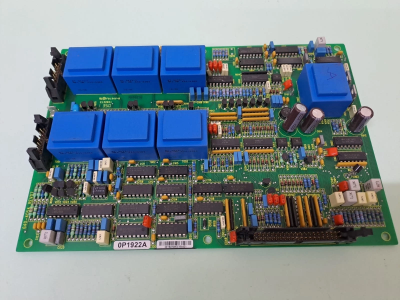
Schneider Electric GUTOR OP1922A Parallel Control Board / Load-Sharing Synchronization Module
Schneider Electric GUTOR OP1922A Parallel Control Board is a highly specialized, mission-critical load-sharing module engineered exclusively for Gutor PEW and PDW industrial-grade uninterruptible power supplies (UPS).
This board serves as the structural foundation for redundant and parallel-capacity UPS architectures. The OP1922A handles the high-speed synchronization, phase-angle locking, and active/reactive load balancing required when multiple standalone UPS cabinets are tied to a single, high-capacity output bus.
Technical Parameter Table
The OP1922A parallel control board is engineered to strict industrial standards to prevent system circulating currents.
| Parameter | Specifications |
| Manufacturer | Schneider Electric / Gutor Electronic LLC (Switzerland) |
| Component Type | Parallel Control Board / Load-Sharing Synchronization Module |
| Model Code | OP1922A (Optimized for multi-unit high-speed communication arrays) |
| System Compatibility | Gutor PEW (3-Phase AC) and PDW (1-Phase AC) Parallel Systems |
| Topological Limit | Supports N+1 Redundant configurations and parallel capacity scaling |
| Synchronization Speed | Microsecond-level active phase-angle matching loop |
| Communication Layer | Dedicated high-speed parallel bus link (Fiber optic / Isolated CAN) |
| Isolation Rating | Galvanic and optical separation between internal cabinet rails and parallel bus |
| Environmental Protection | Full industrial conformal coating protecting against moisture and chemical vapor |
Unique Product Description
The GUTOR OP1922A functions as the dedicated “mediator” between independent UPS units operating in parallel. When two or more UPS systems share a load, even a microsecond deviation in phase, frequency, or voltage amplitude can cause massive “circulating currents” to flow between the cabinets. This imbalance can trip protection systems or damage internal components.
The OP1922A continuously monitors the voltage vectors of all parallel units via a dedicated high-speed inter-cabinet communication bus. It forces the local inverter’s pulse-width modulation (PWM) controller to dynamically adjust its timing, ensuring identical sine-wave alignments across all units. If one UPS fails, the OP1922A instantly commands the remaining units to absorb the load drop with zero break in power.
Product Advantages and Features
Active-Active Load Sharing: Ensures load demands are split equally (within a tight percentage tolerance) across all active UPS systems, preventing single-unit thermal overloading.
Decentralized Parallel Logic: Each cabinet contains its own parallel card, eliminating a single point of failure; if one card or unit goes offline, the remaining parallel network remains operational.
High-Speed Fiber-Optic Isolation: Utilizes isolated, high-speed differential signaling loops that protect inner control processors from external electromagnetic interference (EMI) or fault voltages on the inter-cabinet lines.
Conformal-Coated Durability: Circuit traces are completely sealed with an industrial-grade coating to prevent trace deterioration caused by salt air, conductive carbon dust, or corrosive gases.
OP1922A
Related Models & Same-Series Variations
The OP1922A works in direct tandem with Gutor’s core computational and sensory board layers:
GUTOR OP1922A: (Current Standard) The baseline control card managing inter-cabinet parallel syncing.
GUTOR OP2456 / OP2456B: Main Control CPU Boards (the central processors that receive synchronization adjustments from the OP1922A).
GUTOR OP6290B: Inverter Feedback Acquisition Board (supplies the raw output metrics to the parallel card for vector analysis).
GUTOR OP6281A: Logic Signal Interface Board (routes parallel system trip commands and isolation breaker statuses).
Application Cases
Offshore Gas Platforms and Drillships: Used in N+1 parallel configurations to ensure that if one UPS cabinet undergoes maintenance or experiences a component failure, emergency backup power to drilling controls is never compromised.
Nuclear Power Generating Stations: Implemented in parallel configurations feeding core cooling monitors and plant automation where power availability demands are strictly absolute.
Petrochemical Cracking Facilities: Deployed to scale total output capacity, allowing multiple smaller UPS cabinets to safely drive heavy industrial inductive loads.
Installation and Maintenance
ESD Protection Protocols: This card features high-density, low-voltage communication ICs and optocouplers. Field technicians must utilize grounded ESD wrist straps and static-dissipative mats during installation.
Bus Cable Integrity: The parallel communication cables running between the OP1922A boards must be routed strictly through dedicated low-noise channels away from high-voltage AC or DC busbars to avoid EMI noise injection.
Sequence-Specific Hot-Swap / Upgrades: While Gutor parallel systems allow single-unit isolation for maintenance, the parallel card itself should only be replaced when its specific cabinet is entirely isolated via its in