
OMRON C200HS-CPU01-E SYSMAC PROGRAMMABLE CONTROLLER
OMRON C200HS-CPU01-E SYSMAC PROGRAMMABLE CONTROLLER
PC Terminology
Section 1-4
Although also provided in the Glossary at the back of this manual, the following
terms are crucial to understanding PC operation and are thus explained here.
PC
Inputs and Outputs
Controlled System and
Control System
Because the C200H is a Rack PC, there is no one product that is a C200H PC.
That is why we talk about the configuration of the PC, because a PC is a configu
ration of smaller Units.
To have a functional PC, you would need to have a CPU Rack with at least one
Unit mounted to it that provides I/O points. When we refer to the PC, however, we
are generally talking about the CPU and all of the Units directly controlled by it
through the program. This does not include the I/O devices connected to PC in
puts and outputs.
If you are not familiar with the terms used above to describe a PC, refer to Sec
tion 2 Hardware Considerations for explanations.
A device connected to the PC that sends a signal to the PC is called an input
device; the signal it sends is called an input signal. A signal enters the PC
through terminals or through pins on a connector on a Unit. The place where a
signal enters the PC is called an input point. This input point is allocated a loca
tion in memory that reflects its status, i.e., either ON or OFF. This memory loca
tion is called an input bit. The CPU, in its normal processing cycle, monitors the
status of all input points and turns ON or OFF corresponding input bits accord
ingly.
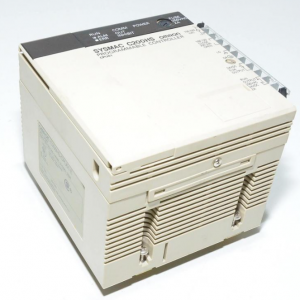
C200HS-CPU01-E
There are also output bits in memory that are allocated to output points on
Units through which output signals are sent to output devices, i.e., an output
bit is turned ON to send a signal to an output device through an output point. The
CPU periodically turns output points ON or OFF according to the status of the
output bits.
These terms are used when describing different aspects of PC operation. When
programming, one is concerned with what information is held in memory, and so
I/O bits are referred to. When talking about the Units that connect the PC to the
controlled system and the places on these Units where signals enter and leave
the PC, I/O points are referred to. When wiring these I/O points, the physical
counterparts of the I/O points, either terminals or connector pins, are referred to.
When talking about the signals that enter or leave the PC, one refers to input
signals and output signals, or sometimes just inputs and outputs. It all depends
on what aspect of PC operation is being talked about.
The Control System includes the PC and all I/O devices it uses to control an ex
ternal system. A sensor that provides information to achieve control is an input
device that is clearly part of the Control System. The controlled system is the
external system that is being controlled by the PC program through these I/O
devices. I/O devices can sometimes be considered part of the controlled sys
tem, e.g., a motor used to drive a conveyor belt.
1-4 OMRON Product Terminology
OMRON products are divided into several functional groups that have generic
names. Appendix A Standard Models list products according to these groups.
The term Unit is used to refer to all of the OMRON PC products. Although a Unit
is any one of the building blocks that goes together to form a C200H PC, its
meaning is generally, but not always, limited in context to refer to the Units that
are mounted to a Rack. Most, but not all, of these products have names that end
with the word Unit.
The largest group of OMRON products is the I/O Units. These include all of the
Rack-mounting Units that provide non-dedicated input or output points for gen
eral use. I/O Units come with a variety of point connections and specifications
High-density I/O Units are designed to provide high-density I/O capability and
include Group 2 High-density I/O Units and Special I/O High-density I/O Units.
Special I/O Units are dedicated Units that are designed to meet specific needs.
These include some of the High-density I/O Units, Position Control Units, High
speed Counter Units, and Analog I/O Units.
Link Units are used to create Link Systems that link more than one PC or link a
single PC to remote I/O points. Link Units include Remote I/O Units, PC Link
Units, Host Link Units, SYSMAC NET Link Units, and SYSMAC LINK Units.
SYSMAC NET Link and SYSMAC LINK Units can be used with the CPU11 only.
Other product groups include Programming Devices, Peripheral Devices,
and DIN Rail Products