

AMAT 0101-57017 PCA, AKT MUX (Multiplexer) Board
AMAT 0101-57017 is a high-performance PCA, AKT MUX (Multiplexer) board developed for the AKT (Applied Komatsu Technology) division of Applied Materials.
This specialized circuit board is a critical component in the testing and inspection systems for large-area glass substrates used in the production of Flat Panel Displays (FPD), including LCD and OLED screens.
It functions as an electronic routing hub, managing high-density signal switching between prober pins and measurement electronics.
Technical Parameter Table
| Parameter | Specification |
| Manufacturer | Applied Materials (AMAT) / AKT |
| Part Number | 0101-57017 |
| Description | PCA, AKT MUX (Multiplexer) Board |
| System Compatibility | AKT Prober Systems / Array Test Platforms |
| Application | Signal Switching and Routing |
| Compatible Series | AKT 15K, 25K, 40K, and 50K series |
| I/O Type | High-Density Multiplexed Signals |
| Weight | Approx. 0.95 kg |
Related Models
The 0101-57017 is often part of an integrated testing rack alongside:
0101-57144: AKT MUX on Prober PCB (6/18 configuration).
0101-57143: Analog measurement or driver board.
0100-71121: AKT Chamber Control CVD 25K Board.
0020-57617: Associated mechanical/interconnect components.
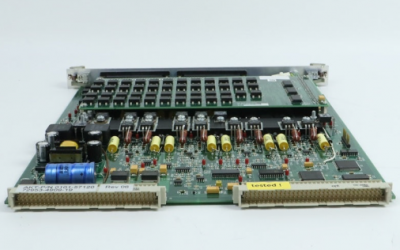
0101-57017
Application Cases
This PCB is a staple in high-volume display manufacturing lines:
TFT-LCD Array Testing: Routing electrical signals from the prober heads to the analysis hardware to verify individual pixel performance.
OLED Quality Inspection: Managing the multiplexed current and voltage measurements required to map uniformity across Generation 6 to Generation 8.5 glass panels.
Defect Localization: Providing the switching logic necessary to isolate specific “zones” on a massive glass substrate during the metrology phase.
Product Advantages and Features
High Channel Density: Engineered to handle hundreds of signal paths, allowing for rapid testing of high-resolution displays without increasing the tool’s footprint.
Low Signal Distortion: Designed with high-grade trace isolation and shielding to maintain the integrity of delicate measurement signals in high-EMF environments.
Seamless AKT Integration: Native compatibility with AKT’s proprietary test software, ensuring plug-and-play functionality during board replacement.
Rugged Cleanroom Design: Built to withstand the rapid mechanical vibrations and thermal fluctuations typical of automated robotic prober stations.
| SHINKAWA | MP-2P4 |
| SHINKAWA | MP-2P1 |
| SHINKAWA | MP-2W2 |
| SHINKAWA | VM-5K SST-2194-001-P001G |
| SHINKAWA | VM-5Y1-02/GEM 1594-005-P001G |
| SHINKAWA | VM-5H3 |
| SHINKAWA | VM-5P3 |
| SHINKAWA | VM-5Z4 |
| SHINKAWA | VM-5C SST-2194-001-P001G |
| SHINKAWA | VM-5G0-2 |
| SIEBEL | IPS21-24V-35AD 3BHE032593R0001 |
| SIEBEL&SCHOLL | IPS21-35AD |
| SIEGER | 05701-A-0361 |
| SIEGER | 05701-A-0502 |
Other Models in the Same Series
AKT 57xxx Series: This series focuses on the metrology and inspection electronics used across the AKT CVD and PVD platforms.
0101-57016: A related variation often used for different prober head configurations or specific substrate sizes.
Installation and Maintenance
Installation: Ensure the prober system is in “Maintenance Mode.”
This board is highly sensitive to Electrostatic Discharge (ESD); always use a grounded wrist strap and antistatic mat. Carefully align the high-density connectors to avoid bending pins during insertion.
Maintenance: Periodically check the connector interfaces for dust or debris, which can cause signal “noise” or false failures during panel testing.
Use electronics-grade isopropyl alcohol (IPA) for cleaning gold fingers if oxidation is present.
Troubleshooting: If the system reports “Multiplexer Timeout” or “Inconsistent Measurement,” verify that the 0101-57017 is fully seated in the card cage and check the status LEDs for power rail stability.
Unique Product Description
The AMAT 0101-57017 is the “sorting office” for display quality data.
In the world of large-area electronics, where every single pixel must be perfect, this MUX board provides the essential switching speed and signal clarity required to scan thousands of test points in seconds.
It bridges the gap between the mechanical probe and the digital analytics suite, making it an indispensable part of the yield-management strategy for modern display fabs.