
SST SST-DN3-PCI-2 DSQC658 high-performance, dual-channel DeviceNet interface card
SST-DN3-PCI-2 (also identified by the ABB part number DSQC658) is a high-performance, dual-channel DeviceNet interface card.
Developed by SST (Molex) and extensively used in ABB IRC5 Robot Controllers,
this PCI-bus card serves as a powerful communication co-processor.
By handling all DeviceNet protocol management on-board, the DSQC658 ensures deterministic, real-time data exchange between the robot’s main computer and peripheral I/O,
sensors, or motor drives without taxing the host CPU.
Technical Parameter Table
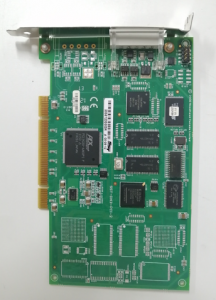
SST-DN3-PCI-2
| Parameter | Specification |
| Model Number | SST-DN3-PCI-2 (ABB DSQC658) |
| ABB Part Number | 3HAC027652-001 |
| Bus Interface | Universal PCI (3.3V / 5V compliant) |
| Channels | Dual Channel (Two independent DeviceNet ports) |
| Processor | 32-bit RISC On-board Co-processor |
| Network Protocol | DeviceNet (Master/Scanner and Slave/Adapter) |
| Baud Rates | 125, 250, and 500 Kbps (Auto-baud supported) |
| Memory | 512 KB Shared RAM per channel |
| Connector | 2x 5-pin Open-style DeviceNet Connectors |
| Isolation | 500V Network Isolation |
| Operating Temp | 0°C to +65°C (32°F to 149°F) |
Related Models
The SST-DN3 family is specifically designed for high-density industrial computing:
SST-DN3-PCI-1: Single-channel version of the PCI interface.
SST-DN3-PC104: Compact version for embedded stacks.
DSQC 613: Older generation ABB DeviceNet interface.
5136-DNP-PCI: Legacy predecessor to the DN3 series.
Application Cases
ABB Robotics: Primarily used in IRC5 M2004 and later controllers to manage end-of-arm tooling (EOAT) and external safety I/O.
Automotive Assembly: Coordinating multi-robot cells where one channel handles internal robot I/O and the second channel communicates with the plant-wide DeviceNet trunk.
PC-Based Control: Serving as a Master/Scanner in high-speed industrial PCs running Soft-PLCs or specialized motion control software.
Material Handling: Controlling complex conveyor systems with hundreds of distributed DeviceNet nodes.
Product Advantages and Features
Dual-Channel Efficiency: Two independent ports allow for network segmentation (e.g., keeping “Safety I/O” on a separate physical wire from “Process I/O”).
ABB Certified: As the DSQC658. it is the factory-standard hardware for IRC5 controllers, ensuring 100% compatibility with ABB RobotWare.
Universal PCI: The “Universal” keying allows it to fit into both legacy 5V and modern 3.3V PCI slots.
Protocol Master/Slave: Can act as a Master to control I/O and a Slave to report data to a higher-level PLC simultaneously.
No Host Overhead: Onboard RISC processing prevents “jitter” in communication, critical for high-speed robotic path corrections.
Installation and Maintenance
Installation
Hardware: Insert into a standard PCI slot. In ABB IRC5 controllers, this is typically located in the main computer unit (Computer Module).
Configuration: For ABB robots, configuration is handled via RobotStudio or the FlexPendant using the system parameters (EIO.cfg).
Wiring: Use shielded DeviceNet cabling. Ensure the 24V DC network power is present, as it powers the card’s opto-isolated transceivers.
Maintenance
LED Diagnostics: The card features dual-color LEDs for each channel. Solid Green indicates a healthy connection; Flashing Red indicates a configuration error or duplicate MAC ID.
Firmware: Firmware is field-flashable. When replacing a unit in an ABB system, ensure the firmware version matches the RobotWare requirements.
Termination: Always verify that 121-ohm resistors are present at both ends of each DeviceNet trunk line connected to the card.
Unique Product Description
The SST-DN3-PCI-2 (DSQC658) is the “Communication Backbone” for modern robotic automation.
While single-channel cards limit your architecture, the dual-channel DSQC658 provides the physical separation necessary for complex safety and process environments.
It is the gold standard for ABB IRC5 systems, offering a “Plug-and-Produce” experience that merges high-speed 32-bit processing with the rugged reliability required on the automotive assembly floor.