

Motorola MVME6100 Series VME Single-Board Computer
MVME6100 Series VME Single-Board Computer
The promise of the VME Renaissance is innovation, performance and investment
protection. The MVME6100 series from Motorola delivers on this promise. The
innovative design of the MVME6100 provides a high performance platform that allows
customers to leverage their investment in their VME infrastructure.
Customers looking for a “technology refresh” for their application, while maintaining
backwards compatibility with their existing VMEbus infrastructure, can upgrade to the
MVME6100 series and take advantage of its enhanced performance features.
The MVME6100 series is designed to meet the needs of OEMs servicing the defense
and aerospace, industrial automation and medical imaging market segments.
2eSST VMEbus protocol with 320MB/s transfer rate
across the VMEbus
Migration path from existing Motorola VMEbus
platforms
High-performance MPC7457 PowerPC® processor
running at 1.267 GHz, ideal for data-intensive
applications
128-bit AltiVec™ coprocessor for parallel processing
Up to 1GB of on-board DDR ECC memory
Two 33/66/100 MHz PMC-X sites allow the addition
of industry-standard, application-specific modules
Dual Gigabit Ethernet interfaces
128MB of Flash memory in two 64MB banks
VMEbus 2eSST Performance
The MVME6100 series is the first VMEbus single-board computer (SBC) designed with the Tundra Tsi148™ VMEbus
interface chip offering 2eSST VMEbus performance. The 2eSST (two edge source synchronous transfer) protocol
causes the VMEbus to run at a practical bandwidth of 320MB/s in most cases. The 2eSST protocol has existed for
some time (the draft standard for trial use was published in 1999 and released as an ANSI standard in 2003), but
until now, 2eSST boards would not work in a standard VMEbus backplane because the existing VMEbus transceivers
could not support the required VMEbus 2eSST signaling speeds. Texas Instruments has developed new VMEbus
transceivers that support the VMEbus signal switching speeds required by the 2eSST protocol. The combination of
the new Texas Instruments VMEbus transceivers and the Tsi148 VMEbus legacy protocol support allows customers
to integrate the MVME6100 series into their existing infrastructure providing backward compatibility and thereby
preserving their investment in existing VMEbus boards, backplanes, chassis and software.
Balanced Performance
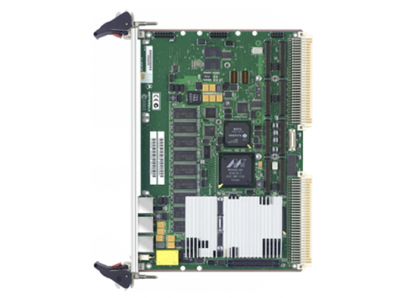
MVME6100
The MVME6100 series provides more than just faster VMEbus transfer rates; it provides balanced performance from
the processor, memory subsystem, local buses and I/O subsystems. The processor running at speeds of 1.267 GHz is
ideal for data-intensive applications. The state-of-the-art host bridge, with support for a 133 MHz host bus and a 133
MHz DDR memory bus, is well matched to the processor. To ensure that the MVME6100 series can handle the
320MB/s data rates of 2eSST, the Tsi148 VMEbus interface chip is connected to one of the 133 MHz PCI-X buses on
the host bridge. The second PCI-X bus has dual PMC-X sites—each site supports PMC or PMC-X cards supporting
PCI bus speeds from 33 to 100 MHz. The MVME6100 also offers dual Gigabit Ethernet interfaces. All of this adds up
to a set of well-balanced, high-performance subsystems for unparalleled performance.
Defense and Aerospace
In the defense and aerospace market segment, the MVME6100 series is well suited for command and control
applications that utilize commercial grade products such as naval sheltered systems, stationary ground systems, and
reconnaissance aircraft systems. The MVME6100 series helps to provide more performance for these applications
than previous VME solutions have been able to supply by using the 1.267 GHz processor. This combined with dual
PCI-X buses capable of 100 MHz speed for PMC modules and an 8x increase in the VME bandwidth eliminates many
of the bottlenecks faced by command and control solutions today. These applications can now take advantage of the
latest PowerPC processors in a dense computing configuration without the difficulties of trying to cool
multiprocessor boards and managing I/O and VME bottlenecks. With the addition of Motorola’s processor PMCs
(PrPMCs), additional PowerPC architecture-compatible processors can be added for a multiprocessor solution
without sacrificing any of the MVME6100 series benefits.
Industrial Automation
The MVME6100 is also ideally suited for semiconductor process equipment (SPE), automated test equipment (ATE)
and a variety of other high-end industrial automation applications because of its increased bus bandwidth and faster
processing speeds. The backwards compatibility of the MVME6100 series with existing VME products helps to
provide OEMs a way to extend the life and capability of their current designs without sacrificing existing key
hardware and software investments. The DSP-like AltiVec technology, which is incorporated into the processor,
allows the MVME6100 series to be used for an assortment of vector processing applications. And with two PMC
sites, the MVME6100 series can be customized