

MOTOROLA MVME5100 SeriesVME Processor Modules
Supercomputing levels of performance in a scalable, single-board computer
The MVME5100 Series is the flagship of the Motorola PowerPlus II VME Architecture
line, enabling supercomputing levels of performance in a single VMEbus slot. Based on
an integrated PCI bridge-memory controller ASIC designed by Motorola Computer
Group, PowerPlus II takes memory performance to new levels with 582MB/s memory
read bandwidth and 640MB/s burst write bandwidth. Plus, PowerPlus II Architecture
supports full PCI throughput of 264MB/s without starving the processor from its
memory.
The extended temperature versions of the MVME5100 Series offer hardware and
software compatible products to enhance the existing MVME5100 product. The new
versions operate at extended temperature ranges of –20° to 71° C vs. 0° to 55° C for
the already existing commercial versions. The temperature range is advantageous to
OEMs that require extended operating temperatures for their equipment.
The MVME5100 is designed to meet the needs of OEMs servicing the defense and
aerospace, industrial automation and medical market segments
MPC7410. MPC750 or MPC755 class microprocessor
with 32KB/32KB L1 cache
■ Up to 2MB of secondary backside cache
■ 100 MHz front-side bus
■ Up to 512MB of on-board ECC SDRAM—expandable
up to 1GB with optional RAM500 memory expansion
modules
■ 17MB Flash memory
■ Dual IEEE P1386.1 compatible 32/64-bit PMC
expansion slots
■ 64-bit PCI expansion mezzanine connector allowing
up to four more PMCs
■ Dual 16550 compatible async serial ports
■ Dual 10BaseT/100BaseTX Ethernet
■ 32KB NVRAM and time-of-day clock with replaceable
battery backup
■ Four 32-bit timers and one watchdog timer
■ On-board debug monitor
■ Single VME slot even when fully configured with two
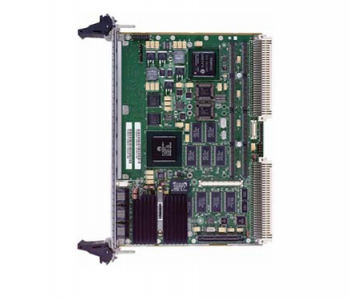
MVME5100
PMC modules and both add-on memory mezzanines
I/O Compatibility
Historically, Motorola has offered two tracks in its
PowerPC Architecture VME portfolio. The first track
(which includes the MVME2600/2700) provides typical
single-board computer I/O features including Ethernet,
SCSI, multiple serial ports, a parallel port and a single
PMC slot. The on-board I/O is routed to P2 and made
available to the user via Motorola MVME761 or
MVME712M transition boards. The second track (which
includes the MVME2300/2400) offers limited on-board
I/O (Ethernet and a single serial port both via the front
panel) but provides dual PMC slots enabling maximum
user I/O customization.
The MVME5100 merges the best features of both tracks
enabling the OEM to support varying I/O requirements
with the same base platform, simplifying part number
maintenance, technical expertise requirements and
sparing.
P2 I/O Modes
The MVME5100 supports two, jumper-configurable P2
I/O modes, PMC mode and IPMC mode.
PMC mode is backward compatible with the
MVME2300/MVME2400. In PMC mode, 64 pins from
PMC slot 1 and 46 pins from PMC slot 2 are available on
P2 for PMC rear I/O.
In IPMC mode, the MVME5100 supports legacy
MVME761 or MVME712M I/O modules (with limited
PMC I/O) when an IPMC761 or IPMC712 PMC card is
populated in PMC slot 1. In this configuration, PMC
slot 2 contains some signals that are reserved for
extended SCSI.
IPMC Modules
The IPMC761 and IPMC712 are optional add-on PMC
modules that provide backward compatibility with
previous-generation Motorola products (such as
MVME2600 and MVME2700) using the MVME761 or
MVME712M transition board. IPMC modules provide
rear I/O support for the following:
• One single-ended Ultra Wide SCSI port
• One parallel port
• Four serial ports (2 or 3 async and 1 or 2 sync/async,
depending on module)
With this PMC card configuration, the memory
mezzanine, one PMC slot and the PMCspan are still
available, providing support for OEM product
customization