

WATLOW 996D Single-Channel Digital Temperature/Process Controller
Watlow 996D is a precision single-channel digital temperature and process controller.
It served as the immediate predecessor to the dual-channel 997 series and was engineered for the stringent accuracy requirements of the semiconductor and high-tech manufacturing industries.
1. Introduction
The 996D is a compact, high-performance controller designed to manage a single thermal or process loop. It features a bright digital display and a tactile keypad for local configuration.
While now discontinued, it remains a staple in legacy semiconductor tools (such as wafer tracks and diffusion furnaces) due to its high sampling rate and specialized OEM firmware options.
It is often found in chassis-mount or 1/8 DIN configurations within complex industrial cabinets.
2. Technical Parameter Table
| Feature | Specification |
| Control Loops | 1 Independent Loop |
| Input Types | Universal (Thermocouples J, K, T, N, E, R, S, B; RTD 100$\Omega$; 4-20mA, 0-10VDC) |
| A/D Resolution | 15-bit to 16-bit |
| Calibration Accuracy | $\pm 0.1\%$ of Span |
| Update Rate | 10Hz (100ms) |
| Outputs | Up to 4 (Switched DC, Mechanical Relay, SSR, or Analog) |
| Power Supply | 100-240 VAC or 24 VDC/VAC |
| Communication | EIA-485 Modbus RTU (Optional) |
| Front Panel Rating | NEMA 4X / IP65 (when panel mounted) |
3. Product Advantages and Features
Industrial Precision: The 0.1% accuracy span makes it suitable for processes where even a half-degree deviation can ruin a production batch.
Fast Sampling: The 10Hz sampling rate allows the PID algorithm to react quickly to thermal disturbances, ensuring a stable setpoint.
Specialized OEM Firmware: Many 996D units feature custom codes (like CUGR or NSRG) which signify factory-tuned parameters for specific semiconductor manufacturing equipment.
Robust Diagnostics: Includes comprehensive error reporting for sensor breaks, reversed thermocouples, and heater failures.
4. Application Cases
Semiconductor Fabrication: Controlling single-zone bake plates and gas delivery line heaters.
Laboratory Research: Precision temperature control for incubators, centrifuges, and chemical reactors.
Plastic Packaging: Managing heat-sealing bars and shrink-wrap tunnel temperatures.
Environmental Testing: Regulating the thermal environment in small-scale stress-test chambers.
5. Other Models in the Same Series
996A: The analog-only variant (no digital display logic).
997D: The dual-channel successor (manages two loops in the same footprint).
998D / 999D: High-accuracy vertical and horizontal 1/8 DIN variants.
Modern Successor: Watlow EZ-ZONE® PM (standard 1/16 DIN replacement).
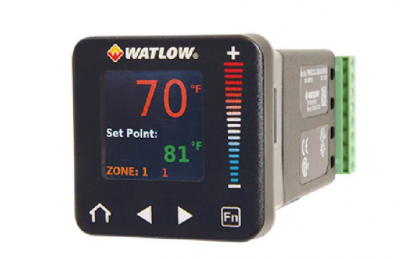
996D
6. Installation and Maintenance
Installation
Mounting: Can be mounted in a standard 1/8 DIN or 1/16 DIN cutout depending on the specific chassis. Ensure the mounting collar is tightened to prevent ingress of moisture or dust.
Wiring: Use shielded thermocouple wire for inputs. Keep signal wires away from high-voltage AC lines to prevent EMI-induced jitter in the readings.
Grounding: Ensure the controller chassis is bonded to the machine’s safety ground to protect the internal 16-bit microprocessor.
Maintenance
Display Inspection: The LED segments can dim over 10+ years of continuous operation. If segments become unreadable, the unit typically requires a front-bezel replacement or full refurbishment.
Battery/Memory: Like other units in this family, the 996D uses non-volatile memory to store PID parameters. If the unit loses its “Job” settings after a power cycle, the internal memory circuit may be failing.
Recalibration: Annual verification with a NIST-traceable millivolt source is recommended for high-precision laboratory or semiconductor applications.
7. Unique Product Description
“The Watlow 996D is the quintessential precision single-loop controller.
Built for an era where reliability was measured in decades, it provides a level of digital stability that redefined the standard for semiconductor thermal management.
It is a compact powerhouse that proves one perfectly controlled zone is better than ten poorly managed ones.”