

WATLOW MLS300-OIT Operator Interface Terminal (Keypad/Display),Discontinued
Watlow MLS300-OIT Operator Interface Terminal
The Watlow Anafaze MLS300-OIT is the dedicated local monitoring and configuration gateway for the MLS300 modular control system.
Although now discontinued, it remains a critical human-machine interface (HMI) for operators managing high-density thermal processes.
1. Introduction
The MLS300-OIT (Operator Interface Terminal) is a remote-mount keypad and display unit designed specifically for the MLS300 multi-loop controller series.
While the “blind” processor modules (MLS-PM) handle the logic and PID control inside the electrical cabinet, the OIT is mounted on the panel door to provide operators with real-time visibility.
It allows for setpoint adjustments, alarm acknowledgment, and full system configuration without opening the enclosure.
2. Technical Parameter Table
| Feature | Specification |
| Display Type | Vacuum Fluorescent Display (VFD), 2-line x 16-character |
| Keypad | 8-key tactile membrane (Embossed) |
| Communication Port | Dedicated OIT port (Serial interface to MLS-PM) |
| Power Requirement | Sourced from the MLS300 Processor Module |
| Mounting | NEMA 4X (IP65) Front Panel Mount |
| Operating Temp | 0°C to 50°C (32°F to 122°F) |
| Cable Length | Standard 5ft or 10ft (Shielded) |
| Dimensions | 1/8 DIN front profile (standard) |
3. Product Advantages and Features
Rugged Construction: The front face is NEMA 4X rated, making it resistant to dust, water, and oil splashes common in industrial environments.
High-Visibility VFD: The bright green Vacuum Fluorescent Display is easily readable from a distance and at wide angles, even in low-light factory conditions.
Tactile Feedback: The membrane keypad is designed for use with gloved hands, providing positive “click” feedback for data entry.
Simplified Navigation: Features a menu-driven interface that allows operators to scroll through all 16 or 32 loops quickly.
Security Lockout: Includes software-based lockout levels to prevent unauthorized changes to critical PID parameters.
4. Application Cases
Plastic Extrusion: Monitoring barrel zone temperatures and adjusting melt setpoints directly at the machine head.
Semiconductor Cleanrooms: Flush-mounting the OIT on the exterior of a tool to monitor wafer processing without contaminating the environment.
Food Processing Ovens: Adjusting ramp/soak recipes on large-scale industrial dryers or baking tunnels.
Heat Treating: Real-time monitoring of multi-zone furnaces to ensure metallurgical compliance.
5. Other Models in the Same Series
The OIT is the “face” of a system that typically includes:
MLS300-PM: Processor Module (The “Brain” the OIT communicates with).
MLS316 / MLS332: Complete 16 and 32-loop base units.
MLS300-AIM: Analog Input Module for sensor expansion.
MLS300-CIM: Communication Interface for SCADA connectivity.
6. Installation and Maintenance
Installation
Cutout: Prepare a standard 1/8 DIN panel cutout ($45\text{mm} \times 92\text{mm}$).
Sealing: Ensure the rubber gasket is seated properly between the OIT and the panel to maintain the NEMA 4X rating.
Connection: Plug the dedicated OIT ribbon or serial cable into the “OIT” port on the MLS-PM.
Note: Never plug/unplug the OIT while the system is powered, as it can damage the serial driver.
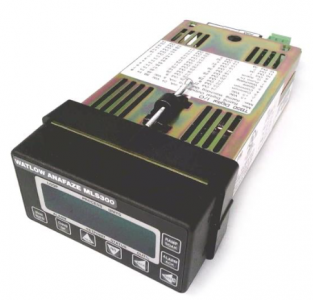
MLS300-OIT
Maintenance
Keypad Cleaning: Use a mild detergent on a soft cloth. Avoid using sharp objects or industrial solvents (like Acetone) which will dissolve the membrane.
VFD Burn-in: If the display is left on the same screen for years, “ghosting” can occur. Use the “Screen Saver” or “Dim” feature found in the system setup menu to extend display life.
Cable Inspection: In high-vibration applications, check that the rear connector hasn’t vibrated loose, which can cause “Communication Error” messages on the screen.
7. Unique Product Description
“The Watlow MLS300-OIT is the industrial window into your thermal world. It distills the complexity of a 32-loop processor into a simple, rugged, and brilliantly bright interface.
As the frontline point of control for the Anafaze legacy, it provides the tactile reliability and visual clarity that operators need to keep production running at peak efficiency.”
| ABB | FET3251C0P184C0H2 |
| ABB | 5SHY35L4503 3BHB004693R0001 3BHB004692R0002 5SXE01-0127 |
| ABB | UAD142A01 3BHE012551R0001 |
| ABB | 3BHE039203R0101 GVC736CE101 |
| ABB | UFD203A101 3BHE019361R0101 |
| ABB | KP2500 |
| ABB | KP3000 |
| ABB | AZ20/112112221112E/STD |
| ABB | PCD235B1101 3BHE032025R1101 |
| ABB | SD822 3BSC610038R1 |
| ABB | PM803F 3BDH000530R1 |
| ABB | PFEA113-20 3BSE028144R0020 |
| ABB | LM80 |
| ABB | AO2000 LS25 |
| ABB | SCYC51020 58052582/G |
| ABB | PP825A 3BSE042240R3 |
| ABB | RED670 |