

WATLOW MLS300-CIM Control Interface Module (Comm Bridge),Discontinued
Watlow Anafaze MLS300-CIM is the Control Interface Module (CIM) for the modular MLS300 series.
Often referred to as a “Communication Bridge,” it acts as the data gateway between the internal controller logic and external industrial networks.
1. Introduction
The MLS300-CIM is a specialized module that adds serial communication capabilities to the MLS300 processor stack.
While the Processor Module (PM) handles the PID calculations, the CIM provides the physical ports and protocols (typically Modbus RTU) required to connect the system to a PC, PLC, or SCADA system.
It translates internal system variables into a format that external devices can read and write, making remote monitoring and automated recipe management possible.
2. Technical Parameter Table
| Feature | Specification |
| Series | MLS300 (Anafaze) |
| Communication Protocols | Modbus RTU (Standard), Anafaze ASCII (Legacy) |
| Physical Interface | EIA/TIA-232, EIA/TIA-485 (Isolated) |
| Baud Rates | 2400 to 19200 bps |
| Max Network Distance | 4,000 ft (1,200m) for RS-485 |
| Isolation | 500VDC to prevent ground loops |
| Power Supply | Sourced from the MLS300 Backplane (5VDC) |
| Status Indicators | LED for Power, Transmit (TX), and Receive (RX) |
| Dimensions | 1.89″ x 3.78″ x 6.75″ (Modular block) |
3. Product Advantages and Features
Isolated Communication: Features optical isolation on the RS-485 port to protect the CPU from voltage spikes and noise common in large heating systems.
Unified Data Access: Allows a single connection to access all parameters for up to 32 loops, eliminating the need for complex multi-drop wiring to individual controllers.
Remote Programming: Enables full system configuration via software (like Anawin or custom PLC logic), reducing the need for manual keypad entry.
Plug-In Expansion: Fits seamlessly into the MLS modular stack with no special tools required for mechanical connection.
4. Application Cases
Distributed Control Systems (DCS): Linking multiple 32-loop MLS300 systems to a central control room in a chemical plant.
Semiconductor Integration: Allowing a host computer to precisely command temperature setpoints and monitor alarms in real-time.
Data Logging: Interfacing with a PC for regulatory compliance and quality reporting in food or pharmaceutical production.
HMI Connectivity: Bridging the controller to graphical touchscreens (e.g., Maple Systems or Red Lion) for local operator control.
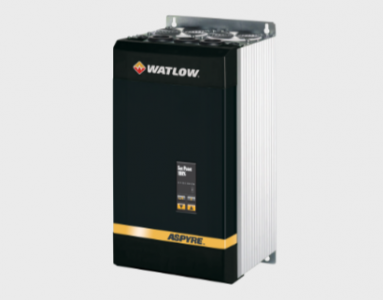
MLS300-CIM
5. Other Models in the Same Series
MLS300-CIM316: A specific variant optimized for 16-loop configurations.
MLS300-PM: The Processor Module (required to use the CIM).
MLS300-AIM: Analog Input Module (the data source for the CIM).
CIM300: An earlier version of the communication interface for legacy stacks.
6. Installation and Maintenance
Installation
Placement: The CIM is usually the last module in the stack. Ensure the side-mounted ribbon cable connector is locked firmly into the adjacent module.
Jumper Settings: Check internal jumpers to select between RS-232 (point-to-point) or RS-485 (multi-drop) modes.
Termination: If the CIM is the last device on an RS-485 bus, install a 120$\Omega$ resistor across the Data+ and Data- terminals to prevent signal reflection.
Maintenance
Comm Port Diagnostics: Use the TX/RX LEDs to verify activity. If the TX light flashes but RX does not, the controller is sending data but not receiving a response from the master device.
Protocol Match: Ensure the Baud Rate, Parity, and Modbus Address in the Global Menu of the Processor Module match the settings of your SCADA system.
Replacement: Since this part is discontinued, ensure the communication cable is not strained, as mechanical stress on the DB-style ports is a common cause of failure in older units.
7. Unique Product Description
“The Watlow MLS300-CIM is the industrial translator for your thermal network. It takes the complex, high-speed internal logic of the MLS300 and converts it into the universal language of Modbus, giving you total visibility of your process from any computer in the world. It is the essential bridge between field-level heat and enterprise-level intelligence.”
| ABB | DSAI146 3BSE007949R1 |
| ABB | 5SHX2645L0004 3BHL000389P0104 3BHB003154R0101 5SXE04-0150/GVC707AE01 |
| ABB | TP830 3BSE018114R1 |
| ABB | REF615E_E HBFHAEAGNCA1BNN1XE |
| ABB | SK827005 SK827100-AS 480V 60HZ |
| ABB | S-073N 3BHB009884R0021 |
| ABB | REF615C_C HCFFAEAGANB2BAN1XC |
| ABB | AIM0006 2RCA021397A0001F |
| ABB | COM0003 2RAA005844A0006A |
| ABB | REF615C_C HCFFAEAGANB2BAN1XC |
| ABB | REF615C_C HCFFAEAGANB2BAN1XC |
| ABB | FENA-11 |
| ABB | P4LQA HENF209736R0003 |
| ABB | 5SHY4045L0001 3BHB018162R0001 3BHE009681R0101 GVC750BE101 |
| ABB | SC540 3BSE006096R1 |
| ABB | 3BHL000986P0006 |
| ABB | XO08R2 1SBP260109R1001 |
| ABB | TU810V1 3BSE013230R1 |
| ABB | PU515A 3BSE032401R1 |
| ABB | PM511V08 3BSE011180R1 |
| ABB | UAD155A0111 3BHE029110R0111 |