

MOTOROLA VME172PA-652SE Embedded Controller with IP Slots
MOTOROLA VME172PA-652SE Embedded Controller with IP Slots
Introduction
The MOTOROLA VME172PA-652SE is a high-performance single-board computer (SBC) from the MVME172P2 series, designed for the VMEbus architecture.
This module leverages the superscalar performance of the MC68060 microprocessor, providing a significant performance leap for legacy embedded systems while maintaining object code compatibility with earlier 68K-based controllers.
Featuring two IndustryPack (IP) slots, the VME172PA-652SE offers exceptional modularity, allowing engineers to customize I/O and functional capabilities for mission-critical industrial and defense applications.
Technical Parameter Table
| Parameter | Specification |
| Manufacturer | Motorola (Legacy) / Emerson Network Power |
| Model Number | VME172PA-652SE |
| Microprocessor | MC68060 (Superscalar RISC-hybrid) |
| Clock Frequency | 60 MHz |
| Main Memory (SDRAM) | 32 MB with ECC (Error Correction Code) |
| Flash Memory | 2 MB |
| Static RAM (SRAM) | 128 KB (Battery-backed) |
| NVRAM / TOD Clock | 8 KB NVRAM + Time-of-Day Clock (MK48T58) |
| I/O Interface | 4x Serial Ports (RJ-45), SCSI, Ethernet (Optional) |
| Expansion Slots | 2x IndustryPack (IP) Slots |
| VMEbus Interface | VMEchip2 (A32/D32 Master/Slave, BLT/MBLT) |
| Operating Temp | -5°C to +55°C (Forced air cooling) |
Related Models
MVME172PA-642SE: 60 MHz variant with 16 MB SDRAM.
MVME172LPA-652SE: Uses the 64 MHz MC68LC060 processor (no FPU).
MVME162P Series: Predecessor series with MC68040 processors and similar IP slot layouts.
PMCspan: Expansion carrier for adding PCI Mezzanine Cards to the VME system.
Application Cases
Defense & Aerospace: Utilized in radar signal processing and flight simulation systems requiring deterministic 68K performance.
Semiconductor Manufacturing: Integrated into wafer handling and lithography equipment control racks.
Industrial Motion Control: Managing complex multi-axis robotic synchronization via specialized IndustryPack I/O modules.
Legacy System Upgrades: Drop-in replacement for MVME147 or MVME162 boards to increase processing throughput without rewriting existing software.
Product Advantages and Features
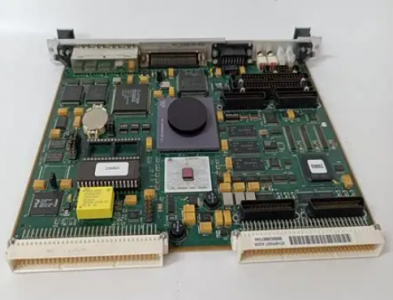
VME172PA-652SE
RISC-Hybrid Performance: The MC68060 core provides workstation-level integer and floating-point math within a rugged VME envelope.
“Petra” ASIC Integration: Replaces older multi-chip designs to improve memory subsystem performance and overall board reliability.
Highly Modular I/O: The dual IP slots support hundreds of third-party modules, from analog-to-digital converters to specialized fieldbus interfaces.
ECC Memory Protection: Ensures data integrity in high-vibration or radiation-prone environments by correcting single-bit memory errors.
Long-Term Reliability: Boasts a demonstrated MTBF (Mean Time Between Failures) of over 190.000 hours.
Other Models in the Same Series
MVME172-213 / 223 (4 MB DRAM variants)
MVME172-533 (High-memory capacity models)
MVME172PA-652SE-2G (Standard industrial configuration)
Installation and Maintenance
Installation: Align the board with the VME chassis guides and slide it into the slot (Slot 1 is required if the board is the System Controller). Ensure the IndustryPack modules are securely fastened to the board before insertion.
ESD Warning: Always use a grounded wrist strap when handling the module to protect the sensitive Petra ASIC and memory chips from static discharge.
Battery Maintenance: The SRAM and TOD clock rely on an onboard lithium battery. Check the battery voltage during annual maintenance; typical service life is 3–5 years depending on power-off duration.
Cooling: Requires a minimum of 490 LFM (Linear Feet per Minute) of airflow to maintain the 55°C operating rating.
Unique Product Description
The MOTOROLA VME172PA-652SE is the bridge between classic 68K reliability and modern processing demands. While many industrial boards sacrifice compatibility for speed,
the VME172PA-652SE preserves your significant software investment while doubling the performance floor.
Its “Petra-based” architecture and dual-IP flexibility make it the definitive choice for engineers who refuse to compromise on the modularity and ruggedness of the VMEbus standard.