

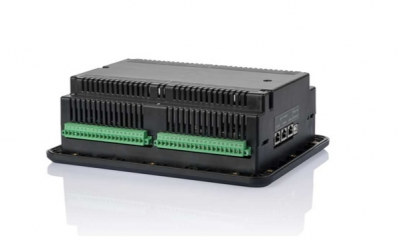
Woodward: easYgen-3500XT-P1-LT 8440-2086
Product number: 8440-2086
Manufacturer product number: 8440-2086
Description: Woodward: easYgen-3500XT (P1/LT), Genset Controller, 1A/5A, Package 1. Low Temperature (-40 °C to 70 °C)
Operation of the circuit breakers
External breaker handling
The configuration of pulse switching takes place in the following
screen and has the described effect on the signal sequence (the
MCB cannot be controlled by the continuous pulse for security rea
sons, because otherwise, the MCB would be opened in case of a
failure/exchange of the easYgen).
The parameter “Enable MCB” allows/prevents the closing of the
MCB. A closed MCB will not be opened.
If the parameter “Auto unlock” is configured to YES, an open pulse
will be issued prior to each close pulse.
In operation mode AUTO the easYgen operates its breakers auto
matically according to the configured application and transition
modes. Actually the breaker transition mode “external” would only
allow the breaker closure from external. On the other hand the
easYgen allows in special cases the closure of breaker from
external, when the following configurations and modes are fulfilled
External Breaker
Handling
Synchroni
zation
Mode
Dead Bus
Closure
Condition for the closure
acceptance
GCB Synchroniza
tion
Off-n The start request in auto
matic is active
n The generator is in oper
ating range
n The engine start procedure
is expired
GCB Dead bus
closure-Off
MCB Synchroniza
tion
Off-The mains is in operating range
GCB Dead bus
closure-Off
… and if GGB is available:
GGB Synchroniza
tion
Off-Minimum 1 GCB is closed
GGB Dead bus
closure-Off
The easYgen provides some application modes, which contain the
handling of the breaker control LS-5. According to the application
mode a single LS-5 or a system of LS-5s is installed. The LS-5
technology shall give the designer an instrument to handle more
complex breaker applications.
Here are some feature examples of the LS-5 technology:
n Open/close of individual breakers including synchronization
and dead bus closure.
n Determining the generators in load share segments.
n Loading/unloading active and reactive power via the dedicated
breaker.
8440-2086
n 3-phase power measurement at the interchange point to the
utility.
n Included mains decoupling functions.
The unit closes the GCB without synchronization, if the following
conditions are met. The display indicates “GCB dead bus close”.
Automatic operation
n The operating mode AUTOMATIC has been selected
n No class C alarm or higher is present
n The engine is running
The engine delayed monitoring (parameter 3315 Ä p. 167) as
well as the generator stable time (parameter 3415 Ä p. 221)
have been expired or the LogicsManager function “Undelay
close GCB” (parameter 12210 Ä p. 221/Ä p. 905) is enabled
n The generator voltage and frequency are within the configured
operating range ( Ä Chapter 4.5.1.1 “ Generator Operating
Ranges: Voltage / Frequency / Busbar” on page 308)
n The MCB has been opened for at least the time configured in
“Transfer time GCB↔MCB” (parameter 3400 Ä p. 218)
(Mode , , , and with open transition mode
only)
n The function “Start without load” (parameter 12540 Ä p. 284/
Ä p. 906/Ä p. 906) has been disabled through the Logics
Manager
n Only in critical mode: the parameter “Close GCB in override”
(parameter 4100 Ä p. 292) is configured to “Yes”
n The busbar voltage is below the dead bus detection limit
(parameter 5820 Ä p. 424)
n There is no other GCB closed in the same segment
n There is no other device with a smaller device ID willing to
close its GCB too (Dead busbar closure negotiation)
Manual operation
n The operating mode MANUAL has been selected.
n No class C alarm or higher is present.
n The engine is running.
n The engine delayed monitoring (parameter 3315 Ä p. 167) as
well as the generator stable time (parameter 3415 Ä p. 221)
have been expired.
n The generator voltage and frequency are within the configured
operating range ( Ä Chapter 4.5.1.1 “ Generator Operating
Ranges: Voltage / Frequency / Busbar” on page 308).
n The button “Close GCB” has been pressed.
n The MCB has been open for at least the time configured in
“Transfer time GCB↔MCB” (parameter 3400 Ä p. 218).
(Mode , , , and with open transition mode
only)
n The busbar voltage is below the dead bus detection limit
(parameter 5820 Ä p. 424).
n There is no other GCB closed in the same segment.
n There is no other device with a smaller device ID willing to
close its GCB too (Dead busbar closure negotiation).
Dead Busbar Negotiation
Each easYgen, who intends to close its GCB on a dead busbar
publishes a “Dead busbar closure request” flag over CANbus and
reads back whether there is any other easYgen publishing the
same intension:
If not, the unit waits an estimated time for security and then closes
its breaker.
If yes, the unit compares its own device number with the smallest
device number of all others who also intend to close. If the own
device number is smaller than the rest, the unit will close its
breaker – otherwise it blocks its own closure.
The easYgen removes its wish to close its GCB on a dead busbar,
if the GCB closure failure occurs in a multiple generator applica
tion. So the next easYgen with the higher device number gets the
permission for closure.