

Woodward TG-17 9904-800 Legacy Mechanical Governors
Internally, the TG-13/TG-17 and TG611-13/TG611-17 governor consists of the following basic items:
• oil pump
• oil accumulator
• speeder-spring
• ballhead and pilot-valve bushing assembly
• pilot-valve plunger
• servopiston
• droop adjustment
• speed adjustment
• terminal lever and shafts
A schematic diagram (Figure 4-1) shows the relationship of these various items and provides a visual
means of understanding the operation of the TG governor.
Description of Operation
Oil Pressure and Distribution
The governor is normally driven by the turbine through a flexible coupling. The inner gerotor of the oil
pump is keyed to the governor drive shaft and pilot-valve bushing. The pump draws oil from the sump and
distributes it through the oil passages within the case. Oil is also discharged to the spring-loaded
accumulator. The relief valve/accumulator maintains 1034 kPa (150 psi) operating pressure at rated
speed for the TG-13/TG611-13 and 1379 kPa
(200 psi) operating pressure at rated speed for the TG-17/TG611-17. Excess pressure compresses the
accumulator springs and oil is released to sump during steady-state operation.
A change in speed and centrifugal force moves the flyweights out or in. This moves the pilot-valve
plunger either upward or downward depending on whether it is an increase or decrease in speed. Plunger
movement opens the control port and releases oil either to sump or to the underside of the servopiston.
During servopiston movement in the increase-fuel direction, the accumulator supplements the system oil
supply with its stored volume of high-pressure oil and helps maintain the full work capacity of the
governor.
Ballhead Operation
The ballhead assembly contains two flyweights, speeder spring, thrust bearing, pilot-valve plunger and
pilot-valve bushing. As the flyweights are rotated, they produce a centrifugal force that is opposed by the
downward force of the speeder-spring. The speeder-spring force can be varied by adjusting the speed
setting screw, or speed-setting lever.
A thrust bearing on top of the flyweight toes permits the pilot-valve bushing to rotate around the pilot
valve plunger. This reduces friction between the bushing and plunger.
Pilot-Valve Function
When the turbine is running at the governor set speed, the pilot-valve plunger is centered, covering the
control ports of the pilot-valve bushing. In this position, no oil is discharged from or flows to the
servopiston, and the governor terminal shaft cannot move. A change in either the flyweight centrifugal
force (speed change) or the speeder-spring force (speed setting) moves the plunger from its centered
position. Plunger movement opens the control port and releases oil either to sump or to the underside of
the servopiston.
The pilot-valve plunger lowers if:
• An additional load slows the turbine and governor speed. This decreases the centrifugal force of the
rotating flyweights which opposes the force for the speeder spring.
• The turbine speed is unchanged, but speeder-spring force is increased by raising the governor
speed setting with the speed-setting screw or speed-setting lever.
Lowering the pilot-valve plunger opens the control ports. High-pressure oil is released to the area below
the servopiston, forcing the servopiston upwards. This rotates the governor terminal shaft in the increase
steam direction.
As the servopiston rises, the speeder-spring force is decreased by movement of the terminal lever and
allows the pilot-valve plunger to rise. The flow of high-pressure oil to the servopiston is closed off by the
control land, stopping the upward motion of the servopiston.
The pilot-valve plunger raises if:
• The centrifugal force of the rotating flyweights is increased by a load decrease on the turbine. This
causes an increase in turbine and governor speed.
• The governor speed is lowered by reducing the speeder-spring force with the speed-adjusting screw.
Raising the pilot-valve plunger again opens the ports, but this time control oil is released to sump from
below the servopiston. High-pressure oil in the area above the servopiston cylinder forces the piston
down. This rotates the terminal shaft in the decrease-steam or fuel direction. Speeder-spring pressure
increases, forcing the pilot-valve plunger downward. Terminal-shaft movement stops as the control land
covers the ports, stopping the release of control oil.
Droop-Adjusting Lever Function
Note that as the terminal lever rotates in the increase-fuel direction, the droop-adjusting lever is lifted and
decreases the speeder-spring force on the flyweights. Thus, the ballhead is allowed to re-center the pilot
valve plunger at lower speeds as fuel is increased. This characteristic is referred to as “speed droop”.
Closing the control port stops further movement of the servopiston simultaneously with the return of
turbine speed to a speed determined by the new speed or spring force.
When moving in the decrease-fue
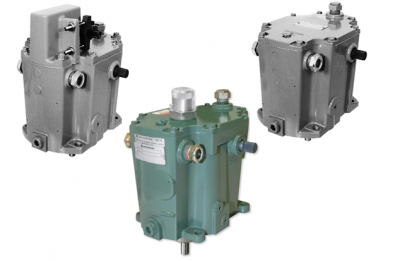
TG-13 and TG-17
TG17 Screw, 2400 rpm, CCW Rotation, ATEX, Rated Speed
@2° Droop = 1950 rpm
9904-800
TG17 Screw, 2400 rpm, CW Rotation, ATEX, Rated Speed
@2° Droop = 1950 rpm
9904-801
TG17 Screw, 2400 rpm, CCW Rotation, ATEX, Rated Speed
@2° Droop = 2010 rpm
9904-802
TG17 Screw, 4000 rpm, CCW Rotation, ATEX, Rated Speed
@2° Droop = 4035 rpm
9904-803
TG17 Screw, 4000 rpm, CW Rotation, ATEX, Rated Speed
@2° Droop = 3910 rpm
9904-804
TG17 Screw, 4000 rpm, CCW Rotation, ATEX, Rated Speed
@2° Droop = 3910 rpm
9904-805
TG17 Screw, 6000 rpm, CW Rotation, ATEX, Rated Speed
@2° Droop = 5860 rpm
9904-806
TG17 Screw, 6000 rpm, CCW Rotation, ATEX, Rated Speed
@2° Droop = 5860 rpm
9904-807
TG17 Lever, 2400 rpm, CCW Rotation, ATEX, Rated Speed
@2° Droop = 2010 rpm
9904-808
TG17 Lever, 2400 rpm, CW Rotation, ATEX, Rated Speed
@2° Droop = 2010 rpm
9904-809
TG17 Lever, 4000 rpm, CCW Rotation, ATEX, Rated Speed
@2° Droop = 4035 rpm
9904-810
TG17 Lever, 4000 rpm, CW Rotation, ATEX, Rated Speed
@2° Droop = 4035 rpm
9904-811
TG17 Lever, 6000 rpm, CCW Rotation, ATEX, Rated Speed
@2° Droop = 6000 rpm
9904-812
TG17 Lever, 6000 rpm, CW Rotation, ATEX, Rated Speed
@2° Droop = 6000 rpm
*Documentation: Product Spec: 04038. Manual: 04042
9904-813