

Fisher™ 4660 High-Low Pressure Pilot
Fisher™ 4660 High-Low Pressure Pilot
The Fisher 4660 pneumatic high-low pressure pilot
activates safety shutdown systems for flowlines,
production vessels, and compressors. This pilot is
available with either single or dual set point capability,
using switch points to maintain full output pressure
when the process pressure is within the set point
range. If the process pressure is outside this range, the
pilot switches from full output pressure to zero output
pressure.
The primary switching mechanism in this pilot is a
block-and-bleed relay assembly. This construction can
be used in both block-and-bleed and bleed-only
systems.
Unless otherwise noted, all NACE references are to
NACE MR0175-2002.
Features
Safety Certification—The 4660 is certified for use in
Safety Instrumented System (SIS) applications.
Certification is by exida Consulting LLC, a global
provider of functional safety and control system
security (see figure 1). SIS certification is identified
on the product by a label affixed to the case.
The functional safety assessment was performed to
the requirements of IEC 61508: ed2. 2010. SIL3 for
mechanical components.
Superior Performance—Repeatability meets the U.S.
Minerals Management Service test tolerances
referenced in Outer Continental Shelf (OCS) Order
No. 5 and defined in the American Petroleum
Institute (API) RP14C standard.
Cost-Effective Design—One pilot provides either a
high-low function or a single switch point,
whichever the application requires
NACE Conformance—A NACE compliant Bourdon
tube is available for those applications where the
pilot must meet the requirements of NACE
MR0175-2002.
Environmental Packaging—Construction materials
have been selected to protect the pilot from
corrosive environments such as the salt spray
atmosphere of offshore platforms.
Reliable Operation—The pilot uses a field-proven
Bourdon tube process pressure sensing element,
shown in figure 2. that reduces maintenance by
eliminating the need for wetted dynamic O-rings.
Reduced Air/Gas Consumption—The 4660
pneumatic high-low pressure pilot is an energy
efficient choice. The low bleed relay provides a
steady state consumption rate that is less than the
6 scfh requirement set for the oil and gas industry
by the US Environmental Protection Agency
(New Source Performance Standards Subpart
OOOO, EPA-HQ-QAR-2010-0505).
Vibration Resistance—The rugged Bourdon tube
sensing element and shock-absorbing switch points
dampen the effects of vibration while maintaining
performance.
Set Point Accuracy—Standard high-resolution set
point adjustments are easy to set, non-interactive,
and can be locked in place to maintain the desired
set point. The optional set point indication
assemblies on the front panel are easy to read and
let you simply dial in the desired set point.
Figure 2. Fisher 4660 High-Low Pressure Pilot with
Block and Bleed Relay; Left Side with Case Cover Off
SET POINT ADJUSTMENTS
X0232
BOURDON TUBE
BLOCK AND
BLEED RELAY
Easy Maintenance—Simple modular construction
plus a line of prepackaged parts kits makes pilot
maintenance fast and easy.
Installation Versatility—Panel, rack, pipestand, or
actuator mounting is available to meet field
requirements.
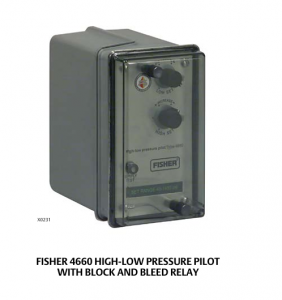
Fisher™ 4660
Operational Indications—A supply pressure test
function is provided. The optional output indicator
lets you check at a glance whether the pilot output
pressure is at full output or zero output pressure.
Available Configurations
High-low, low-only, or high-only set point
capability
Input Signal
Type: Process pressure sensed with a Bourdon tube
Bourdon Tube Ratings: See table 1 or 2
Overpressure Protection: Maximum allowable
emergency process pressures and maximum
allowable process pressures to ensure set point
readjustability are shown in table 3
Output Signal
Zero pressure or full supply pressure
(automatically resets)
Supply Pressure(1)
Normal Operating Pressure: 1.4 to 4.4 bar
(20 to 65 psig)
Medium: Air or Natural Gas
Supply medium must be clean, dry, and noncorrosive
Steady-State Air Consumption(2)
Output Signal at 0 psig: ≤0.134 normal m3/hr
(≤5 scfh)
Output Signal at Full Supply Pressure:
≤0.00134 normal m3/hr (≤0.05 scfh)
Set Point Adjustments
Continuously adjustable between 3% and 97% of
Bourdon tube rating; see table 1 or 2 for ranges
Performance in Percentage of Bourdon Tube Rating
Repeatability: ≤0.25%
Set Point ΔPmin .
(See table 1 or 2)
Single High-Low Unit: 10% for up to 170 bar (2500
psig) Bourdon tubes; 15% for 350. 500. and 700
(NACE) bar (5000. 7500. and 10.000 (NACE) psig)
Bourdon tubes
Low-Only and High-Only Pair: 3%
Trip-to-Reset Zone: ≤1.5% (see table 1 or 2)
Exhaust Capacity
Cg ≥15
Construction Materials
Case and Cover: Polyester
Front Cover: Tinted polycarbonate with
scratch-resistant coating
Base: Hard-anodized nickel-sealed aluminum alloy
Bourdon Tube: S31600 SST or NACE compliant
material
Relay Body, Relay Flange, Nozzle/Flapper Assembly
Orifice Block, and Switch Point Housings: Glass-filled
polyphenylene sulfide
Relay Diaphragm: Fluorosilicone/Polyester
Relay Discs: Fluorosilicone
Process Pressure Block, Tubing, Front Plate, Flapper,
Linkages, and Other Major Metal Parts: Stainless steel
Gaskets: Chloroprene and nitrile
O-Rings.
Relay: Nitrile
Switchpoint Assembly: Nitrile impregnated with
molybdenum disulphide
Base/Case: Nitrile
Operating Conditions(1)
Condition
Normal Operating Limits
Ambient
Temperature-59 to 71C (-75 to 160F)
Nominal
Reference
21C (70 F)
Operating Influences on Switch Point Sensitivity
Supply Pressure: ≤0.05% of Bourdon tube rating for a
10% change in supply pressure
Ambient Temperature: ≤2% of Bourdon tube rating
throughout normal operating limits with nominal
reference
Time: ≤1% of Bourdon tube rating over 30 days at
ambient temperature nominal reference
Process Pressure: Range shift or set point drift can
occur if process pressure exceeds the Bourdon tube
rating
Fisher™ 4660
Pressure Connections
1/4 NPT internal
Mounting
Panel,
rack,
pipestand, or actuator
Specifications (continued)
Hazardous Area Classification
Complies with the requirements of ATEX Group II
Category 2 Gas and Dust
Ex h IIC Tx Gb
Ex h IIIC Tx Db
Maximum surface temperature (Tx) depends on
operating conditions
Gas: T6
Dust: T71
Meets Customs Union technical regulation TP TC
012/2011 for Groups II/III Category 2 equipment
II Gb c T*X X
III Db c T*X X
Safety Instrumented System Classification
SIL3 capable certified by exida Consulting LLC
Approximate Weight
2.3 kg (5 pounds)
Options
Visual output indication stainless steel panel
mounting flange, set point indication, and
tamper-resistant front cover
Principle of Operation
Refer to figure 3.
Process pressure is connected to the Bourdon tube
sensing element. While the process pressure remains
in the adjusted set ranges (between the low set point
and the high set point), the flapper does not contact
either set point pivot. This keeps the nozzle capped
and maintains full output pressure.
As the process pressure decreases below the low set
point value, the radius of arc of the Bourdon tube
contracts. This causes the flapper to contact the low
set point pivot and uncap the nozzle, which blocks
supply pressure and vents (bleeds) output pressure. As
the process pressure increases above the high set
PROCESS PRESSURE
LOW SETPOINT ADJUSTMENT
HIGH SETPOINT
ADJUSTMENT
SPRING
BLOCK AND BLEED
RELAY ASSEMBLY
SUPPLY PRESSURE
OUTPUT PRESSURE
point value, the radius of arc of the Bourdon tube
extends. This causes the flapper to contact the high set
point pivot, also uncapping the nozzle and providing
block-and-bleed action. When the process pressure
returns to the set range, the nozzle is again capped,
switching the relay back to maintain full output
pressure.
Performance
The performance characteristics discussed in the
Performance in Percentage of Bourdon Tube Rating
specification on page 3 and shown in figure 4
illustrate several important functional parameters.
SL represents the low set point and SH represents the
high set point. The set range capability is 3 to 97
percent of the Bourdon tube rating. However, with a
single high-low unit or a high-only/low-only pair, there
is a limit on how close to each other the set points can
be adjusted. This limit is defined as set point ΔPMIN and
is shown as SL′ and SH′.
Trip-to-reset is the combined effect of pilot deadband
and hysteresis. After the pilot has tripped, it
automatically resets when the process pressure
returns to the set range. However, full output pressure
is not instantaneous. The difference between the set
point and reset to full output pressure is the
trip-to-reset zone. This parameter is also a function of
the Bourdon tube rating as shown in figure 4 and
discussed in the Performance in Percentage of
Bourdon Tube Rating specification on page 3.
Repeatability is the switch point deviation around the
set point as a percentage of the Bourdon tube rating.
Applications
Figure 5 shows some of the many ways in which the
4660 high-low pressure pilot may be connected to
accommodate requirements for single and dual
outputs as well as single and dual process pressure
lines. Examples A and D in figure 5 show how a pair of
high-only and low-only pilots are connected to obtain
closer set points as specified by the set point ΔPMIN
values in tables 1 and 2. Example B or C shows
connections for a two-segment flow line configuration
that adheres to API Specification RP14C. Example E
shows a typical connection to an electrical pressure
switch
Installation
Normal installation is with the pilot mounted vertically
and the connections for process pressure, supply
pressure, and output pressure facing down. The supply
medium should be regulated dry air or natural gas with
solid particles removed.
Figures 6 and 7 illustrate the mounting dimensions
and the location of the pressure connections.
Ordering Information
When ordering, specify:
Application
Bourdon tube rating and material
Composition, pressure, and temperature of the
process fluid
Ambient temperature range
Description of application
Construction
Refer to the Specifications table. Review the
information under each specification and in the
referenced tables; specify the desired selection
whenever there is a choice to be made