

Woodward 85018V1 Turbine Control Parameters
Turbine Control Parameters
The 505E interfaces with two control valves (HP & LP) to control two parameters
and limit an additional parameter, if desired. These two controlled parameters are
typically speed (or load) and extraction/admission pressure (or flow), however,
the 505E could be utilized to control or limit: turbine inlet pressure or flow,
exhaust (back) pressure or flow, first stage pressure, generator power output,
plant import and/or export levels, compressor inlet or discharge pressure or flow,
unit/plant frequency, process temperature, or any other turbine related process
parameter. Refer to Volume 2 for details on applications.
Communications
The 505E can communicate directly with plant Distributed Control Systems
and/or CRT based operator control panels, through two Modbus® *
communication ports. These ports support RS-232. RS-422. or RS-485
communications using ASCII or RTU MODBUS transmission protocols.
Communications between the 505E and a plant DCS can also be performed
through hardwired connections. Since all 505E PID setpoints can be controlled
through analog input signals, interface resolution and control is not sacrificed.
*—Modbus is a trademark of Schneider Automation Inc.
Additional Features
The 505E also provides the following features: First-Out Trip Indication (5 total
trip inputs), Critical Speed Avoidance (2 speed bands), Auto Start Sequence (hot
& cold starts), Dual Speed/Load Dynamics, Zero Speed Detection, Peak Speed
Indication for Overspeed trip, and Isochronous Loadsharing between units.
Using the 505E
The 505E control has two normal operating modes, the Program Mode and the
Run Mode. The Program Mode is used to select the options needed to configure
the control to your specific turbine application. Once the control has been
configured, the Program Mode is typically never again used, unless turbine
options or operation changes. Once configured, the Run Mode is used to operate
the turbine from start-up through shutdown. In Addition to the Program and Run
modes, there is a Service Mode which can be used to enhance system operation
while the unit is running. Refer to Volume 2 for information on the Service Mode.
505E Inputs and Outputs
Control Inputs
Two speed inputs which are jumper configurable for MPU (magnetic pickup units)
inputs or proximity probes.
Six analog inputs are available. One is dedicated as the extraction/admission
input. The remaining five are configurable. The sixth analog input has isolation
circuitry and should be used for a self-powered signal that is not isolated.
Sixteen contact inputs are available. Four are dedicated for shutdown, reset,
raise speed setpoint, and lower speed setpoint. Another two contact inputs must
be dedicated for generator breaker and utility tie breaker if the control is used in a
generator application. Ten additional contact inputs can be configured. If the unit
is not used in a generator application, then twelve additional contact inputs can
be configured.
Four function keys on the front panel of the control. F1 and F2 are dedicated to
alarm and overspeed test, respectively. F3 and F4 can be used to enable or
disable various functions of the control.
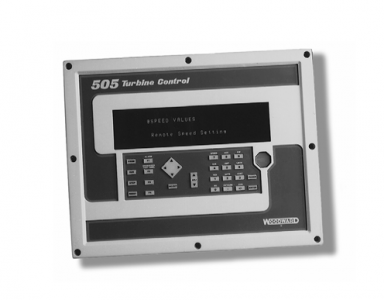
85018V1
Control Outputs
Two actuator outputs with linearization curves for the HP and the LP valve
outputs.
Six 4–20 mA outputs, for meters or other readouts.
Eight Form-C relay contact outputs, six that are configurable. The two dedicated
relay outputs are for shutdown and alarm indication.
Control Communications
Two Modbus ports, to be used as control interfaces. The protocol can be either
ASCII or RTU and the communications can be RS-232. RS-422. or RS-485.
One computer (PC) port to be used for program configuration storage.
An overview of the 505E functions is shown in Figure 1-1. Use this block diagram
to match the control features to the site-specific application required.
The 505E Digital Governor is designed to control extraction, extraction/
admission, or admission steam turbines. The difference between these turbines
is the capability of the turbine to allow low pressure steam, which is at a lower
pressure than the inlet, to enter and/or exit the turbine. An extraction turbine
allows the lower pressure (extraction) steam to exit the turbine only and will have
a non-return valve in the extraction header/line to prevent steam from entering
the turbine. An admission turbine (also called induction) will allow excess header
steam to enter the turbine through the low pressure inlet. An extraction/admission
turbine will allow low pressure header steam to enter or exit the turbine
depending on system pressures. A turbine with admission capability will have a
stop valve or trip-and-throttle valve in the low pressure line to prevent steam from
entering the turbine when the unit is tripped. The type of turbine used will depend
on the system requirements and must be designed by the turbine manufacturer
to perform the functions required.
The 505E has two independent control channels available, the speed/load and
auxiliary controllers. The outputs of these two controllers are low-signal-selected
(LSS) to provide to speed/load demand signal to the ratio/limiter. In addition to
these channels, the speed/ load controller can be manipulated by another
controller, the cascade controller. The cascade controller is ‘cascaded’ into the
speed controller, whereby the speed controller setpoint is changed directly by the
cascade controller output. The auxiliary controller can act as either a control
channel or as a limiting channel. All three of these PID controllers have the
option of utilizing an analog input signal to remotely position their setpoints.
Additional features of the 505E include frequency control, isochronous
loadsharing, critical speed avoidance, idle/rated control, and an automatic start
sequence. There are two serial communications ports which can be used to
monitor and control the turbine using Modbus protocol.
Extraction Turbines
The 505E control can be configured to operate single automatic extraction
turbines by controlling the interaction of the governor (HP or high pressure) valve
and the extraction (LP or low pressure) valve. (The 505E can also operate the
governor valve and the first extraction valve of multiple extraction turbines).
Single automatic extraction turbines have a high pressure stage and a low
pressure stage, each controlled by a valve. Steam enters the turbine through the
HP valve (see Figure 1-2). At the downstream end of the HP turbine stage and
before the LP valve, steam can be extracted. The LP valve controls the entry of
steam into the LP turbine stage, and the diverting of steam through the extraction
line. As the LP valve is opened, more steam enters the LP stage and less is
extracted.
In most cases, the operator of an extraction turbine needs to maintain both
turbine speed/ load and extraction pressure/flow at constant levels. Changing the
position of either the HP valve or the LP valve affects both turbine speed/load
and extraction. If either the load on the turbine or the extraction demand
changes, both the
Admission Turbines
The 505E control can be configured to operate single automatic admission
turbines by controlling the interaction of the governor (HP or high pressure) valve
and the extraction (LP or low pressure) valve.
Single automatic admission turbines have a high pressure stage and a low
pressure stage, each controlled by a valve. Steam enters the turbine through the
HP valve (see Figure 1-3) and at the downstream end of the HP turbine stage,
before the LP valve. The LP valve controls the entry of steam into the LP turbine
stage and through the admission line. As the LP valve is opened, more steam
enters the LP stage.
In most cases, the operator of an admission turbine needs to maintain both
turbine speed/ load and admission pressure/flow at constant levels. Changing the
position of either the HP valve or the LP valve affects both turbine speed/load
and admission. If either the load on the turbine or the admission demand
changes, both the HP valve position and the LP valve position must be changed
to maintain speed/load and admission.
The movement of both valves is automatically calculated by the 505E’s ratioing
logic based on the turbine performance parameters to minimize valve/process
interaction.
Extraction and Admission Turbines
The 505E control can be configured to operate single automatic extraction and
admission turbines by controlling the interaction of the governor (HP or high
pressure) valve and the extraction (LP or low pressure) valve.
Single automatic extraction and admission turbines have a high pressure stage
and a low pressure stage, each controlled by a valve. Steam enters the turbine
through the HP valve (see Figure 1-2). At the downstream end of the HP turbine
stage and before the LP valve, steam can either be extracted or admitted
(inducted) into the LP turbine stage. The LP valve controls the entry of steam into
the LP turbine stage. As the LP valve is opened, more steam enters the LP stage
and less is extracted.
In most cases, the operator of an extraction turbine needs to maintain both
turbine speed/ load and extraction or admission pressure/flow at constant levels.
Changing the position of either the HP valve or the LP valve affects both turbine
speed/load and extraction or admission. If either the load on the turbine or the
extraction / admission demand changes, both the HP valve position and the LP
valve position must be changed to maintain speed/ load and extraction/
admission. The movement of both valves is automatically calculated by the
505E’s ratioing logic based on the turbine performance parameters to minimize
valve/process interaction.
Speed Control
The speed control receives a turbine speed signal from one or two magnetic
pickups or proximity probes. The speed PID (proportional, integral, derivative)
control amplifier then compares this signal to the speed setpoint to generate an
output signal to the ratio/ limiter (through a low signal select bus).
Extraction/Admission Control
The Extraction/Admission (Extr/Adm) control receives an extraction/admission
(4–20 mA) signal from a pressure or flow transducer. The Extr/Adm PID
controller then compares this signal to the setpoint to generate an output signal
to the Ratio/Limiter.
The Extr/Adm control can also receive a programmable (optional) droop
feedback signal to increase the stability of the extraction control loop.
The Extr/Adm setpoint is adjustable with raise or lower commands through the
keypad on the front of the control, the remote contact inputs, or the
communication links. Also, the setpoint can be directly set by entering the new
setpoint from the keypad or through either Modbus communications link. In
addition, a remote extr/adm setpoint analog input can be programmed to
remotely position the Extr/Adm setpoint.
Remote Extraction/Admission Setpoint
One of the 4–20 mA inputs can be configured to remotely adjust the Extr/Adm
setpoint. The remote setpoint input directly affects the 505E’s Extr/Adm setpoint.
The maximum rate at which the remote input signal can change the setpoint is
programmable and can be changed in the Run mode. When the remote setpoint
is enabled, the Extr/Adm setpoint will move at a much slower rate until the two
settings are matched, at which point the setpoint will be allowed to move at the
maximum rate. The remote setpoint function can be enabled and disabled as
required from the front-panel keypad, the remote contact inputs or either Modbus
communication link.
Ratio/Limiter
The Ratio/Limiter receives input signals from the speed (or aux) and extr/adm
control PIDs. The ‘ratio’ logic uses these signals and, based on the turbine
performance parameters, produces two output signals, one to control the HP
actuator and one to control the LP actuator. The ‘limiter’ logic keeps the actuator
outputs within the boundaries of the turbine steam map.
The ratio logic controls the interaction of both HP and LP valves to maintain
desired turbine speed/load and extraction/admission pressure/flow levels. By
controlling valve interaction, the ratio logic minimizes the effects of one controlled
process on the other controlled process.
When speed/load or extraction/admission demands cause the turbine to reach an
operating limit, the limiter logic limits the HP or LP valves to maintain speed/load
or extraction/ admission demands depending on the priority selected