

UCSC compact quad-core controller IUCSC H1 IS420UCSCH1A-B
GE IS420UCSCH1A-B (IUCSC H1) is the UCSC compact quad-core controller of the Mark VIe series.
It adopts the QNX Neutrino real-time system and supports TMR/dual-machine/simplex redundancy.
Focusing on high-speed real-time computing and safe and reliable control for key industrial controls such as gas turbines.
The following are the core information and technical details:
I. Core Positioning and Basic Attributes
Project parameters
Model IS420UCSCH1A-B (IUCSC H1)
Brand GE Vernova (formerly GE Gas Power)
Series Mark VIe/Mark VIeS
Type UCSC Compact Controller (Compact Controller)
CPU 1.2GHz quad-core AMD G-Series
Operating system QNX Neutrino (Real-time Security)
Redundancy supports TMR (Triple Module Redundancy), Dual (Dual machine), and Simplex (Simplex)
It is equipped with 2 Hall pulse inputs, 2 analog inputs and 4 digital I/O channels
Typical applications include gas/steam turbines, combined cycle power generation, and industrial process control (SIL3 safety level compatible)
Ii. Key Technical Specifications
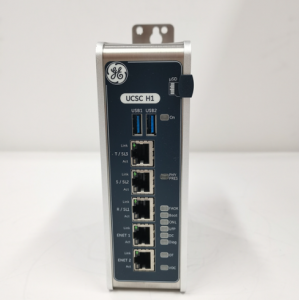
IS420UCSCH1A-B
Core performance
Computing power: 1.2GHz quad-core, supporting multi-threaded parallel processing of complex control logic and high-speed data interaction.
Storage: On-board RAM and Flash, compatible program solidification, data caching and fault recording.
Communication: Dual redundant Ethernet ports (supporting IONet, Ethernet/IP, Modbus TCP, etc.), supporting EFA (Embedded Field Agent) connection to Predix cloud to achieve remote monitoring and data analysis.
Environment and Physics
Operating temperature: -40℃ to 85℃ (storage), 0℃ to 60℃ (operation).
Power consumption: Approximately 15W (24V DC power supply, ±10%).
Weight: approximately 1.33kg, compatible with standard Mark VIe rack mounting.
Iii. Core Functions and Applications
Real-time control: Execute complex algorithms such as turbine control, sequential logic, and PID to meet the millisecond-level control closed loop.
Redundancy and fault tolerance:
Three-mode voting in TMR mode, non-intrusive switching in case of failure, suitable for safety-critical scenarios; Dual-machine/simplex design is suitable for different reliability requirements scenarios.
Data interaction:
By connecting the IS420 series I/O modules (such as the IS410TRLYS1B relay board) via IONet, it supports digital/analog signal acquisition and output, and is simultaneously interconnected with HMI, SCADA, and other controllers via Ethernet.
Safety and Diagnosis:
SIL3 compatibility, built-in self-diagnosis and logging for faults, EFA technology supports remote operation and maintenance as well as predictive maintenance.
Iv. Selection and Supporting Tips
Redundant configuration:
TMR requires 3 sets of controllers + matching I/O, dual-machine requires 2 sets, and simplex requires 1 set. Select according to the system safety level.
Expand I/O:
Expand I/O packages such as IS420YDO and IS420ADC through IONet to match the on-site signal type and the number of channels.
Version differences:
Compared with IS420UCSBH1A (600MHz dual-core UCSB controller), UCSC has stronger performance, more complete redundancy, and is suitable for more complex control scenarios.
V. Core Advantages
High reliability:
QNX system + redundant design ensures continuous operation of critical equipment.
High performance:
The quad-core processor supports complex algorithms and concurrent multitasking.
Easy integration: Compact design, compatible with the Mark VIe ecosystem, and adaptable to the upgrade and expansion of new and old systems