

GE Fanuc Automation VMICPCI-7806 Specifications
GE Fanuc Automation VMICPCI-7806
Functional Characteristics
Microprocessor: The VMICPCI-7806 is based on the Pentium M
processor family. The enhanced Pentium M processor has
1 Mbyte of L2 cache while the Celeron M has 512 Kbyte of L2
cache. The Pentium/Celeron M processor family offers thermal
characteristics that are well suited for embedded systems
operating over a wide range of temperatures.
DRAM Memory: The VMICPCI-7806 accepts one 200-pin
SODIMM DDR module for memory configurations of 256 Mbyte,
512 Mbyte and 1 Gbyte.
BIOS: The VMICPCI-7806 System BIOS and video BIOS are
provided in reprogrammable memory.
Video Graphic Controller: High-resolution graphics and
multimedia-quality video are supported on the VMICPCI-7806
by an internal graphics controller. A fully functional, integrated
2D/3D graphics accelerator provides pixel processing and
rendering, with display resolutions of up to 1600 x 1200
supported. The video output is provided through the
CompactPCI connector. Support is provided for both analog and
LVDS digital video.
NOTE: Standard video BIOS support for LVDS is for an 800 x 600
panel only. If the VMIACC-0584 back panel is not used, then the
video should be disabled via CMOS setup.
CompactFlash: The VMICPCI-7806 includes a CompactFlash
socket on the assembly. The CompactFlash may be configured
as the boot device through the BIOS boot device set up. See the
CompactFlash ordering options for the available sizes.
IDE Interface: The VMICPCI-7806 provides an IDE interface for
hard disk drive support. The IDE interface allows support of
several types of data transfers: Programmed I/O (PIO),
8237 style DMA, Ultra ATA/33. Ultra ATA/66 and Ultra ATA/100.
NOTE: Ultra DMA IDE modes require a high performance
80 conductor cable.
Ethernet Controller: The VMICPCI-7806 provides a dual
connection for 10/100/1000BaseTX LAN using the Intel 82546EB
Ethernet controller. Two standard RJ45 connectors are provided
on the front panel with two network status indicators. Both LAN
ports supporting PICMG 2.16. Rev 1.0 are also available via the
CompactPCI backplane.
Serial ATA: The VMICPCI-7806 provides a serial ATA interface via
the CompactPCI backplane connector.
Remote Ethernet Booting: The VMICPCI-7806 utilizes an
Expansion ROM BIOS which enables processor booting from a
network server. The facility supports PXE and a variety of
network boot protocols including BOOTP and DHCP (TCP/IP).
USB Ports: The VMICPCI-7806 provides two high speed universal
serial bus (USB 2.0) ports. The ports are available on the
CompactPCI backplane connectors.
Serial Ports: The VMICPCI-7806 provides two 16550-compatible
serial ports. Each serial port has an independent 16-byte FIFO
supporting baud rates up to 115 Kbaud. Connection for one
serial port is provided by an RJ45 connector located on the front
panel. Both serial ports are available via the CompactPCI
connector.
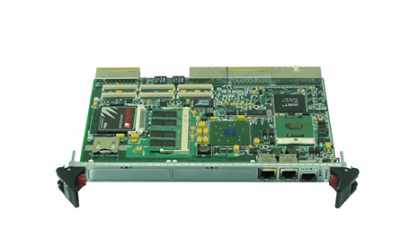
VMICPCI-7806
PMC Expansion Sites: The VMICPCI-7806 provides two individual
IEEE 1386.1 PCI mezzanine card (PMC) expansion sites. This
expansion capability allows the addition of peripherals offered
for PMC applications. One PMC site is 3.3V 64-bit, 66 MHz, while
the second site is 5.0V 32-bit, 33 MHz.
Keyboard and Mouse Ports: The VMICPCI-7806 supports a PS/2
keyboard and mouse through the CompactPCI connector using
the optional VMIACC-0584 backplane adapter.
Hardware Reset: A hardware reset switch is accessible from the
front panel.
Watchdog Timer: The VMICPCI-7806 provides a software
programmable watchdog timer. The watchdog timer is enabled
under software control. Once the timer is enabled, software
must access the timer within the specified time period, or the
output of the watchdog timer will either interrupt or reset the
unit. The reset or interrupt operation is programmable.
Annunciators: Indicators for the primary IDE interface activity,
board status, power good and a blue LED for hot swap are
provided on the front panel. In addition, two indicators for the
Ethernet adapter activity are located on each RJ45 network
connector.
Thermal Management: The VMICPCI-7806 utilizes a passive
heat sink that relies on forced air cooling within the equipment
rack at the specified flow rate. Please refer to the environmental
specifications for more information.
CompactPCI Bus Bridge: The VMICPCI-7806 is a universal
CompactPCI single board computer (SBC) supporting
applications as both a system slot controller or a peripheral slot
controller. The PCI-to-PCI bridge interface to the CompactPCI
bus is automatically configured to operate as either a
transparent or non-transparent bridge. This implementation is
fully compliant with PICMG 2.0 Rev 3.0. PICMG 2.1 Rev 2.0. and
PCI-to-PCI Bridge Architecture Rev 1.1.
IPMI: The VMICPCI-7806 provides PICMG 2.9 Rev 1.5 IPMI
support via the Zircon PM Peripheral Management Controller.
High Availability Hot Swap: The VMICPCI-7806 complies with
PICMG 2.1 Rev 2.0 standard for CompactPCI hot swap. The
VMICPCI-7806 complies with the high availability provisions of
this standard. The processor may be removed and replaced
while the system is operational. Processing can automatically
be switched to a backup SBC that was previously installed in the
system.
CMOS Battery: The VMICPCI-7806 uses a holder that permits
field replacement of the CMOS battery. A header and jumper
allows the battery to be disconnected from the circuitry for
long-term storage.
Back Panel Configuration: The VMICPCI-7806 provides support
for several peripherals using the CompactPCI backplane
connectors. These signals are routed to the CompactPCI J3 and
J5 connectors. This permits connection of the external IDE disk
drive, floppy drive, USB, SATA, video, and keyboard and mouse
via the VMIACC-0584 backplane adapter. Connection to these
signals is provided to facilitate application development.
NOTE: If the VMICPCI-7806 is not used with the VMIACC-0584
back plane adaptor, the user is responsible for either
terminating video, SATA and USB or for disabling these features
in the CMOS setup.
Operating System and Software Support
The VMICPCI-7806 supports a variety of operating systems
including Microsoft® Windows 2000. Windows XP, QNX, Linux
and VxWorks.
Physical/Environmental Specifications
Dimensions: 6U (4HP) single slot Eurocard form factor
Height
Depth
Thickness
9.2 in. (233.4mm)
6.3 in. (160mm)
0.8 in. (20.3mm
Power Requirements: Low Power/Extended Temperature option
Pentium M 1.4 GHz (1 Gbyte Memory)
+5VDC (+5. -3 percent), 1.5A (typical), 3.5A (maximum)
+3.3VDC (+5. -3 percent), 1.5A (typical), 1.8A (maximum)
+12.0VDC (+5. -3 percent), 50 mA maximum -12VDC (+5. -3 percent), 50 mA maximum
Pentium M Processor (1 Gbyte Memory)
+5VDC (+5. -3 percent), 4.5A (typical), 6.75A maximum
+3.3VDC (+5. -3 percent), 1.5A (typical), 2.0A maximum
+12.0VDC (+5. -3 percent), 50mA maximum -12VDC (+5. -3 percent), 50mA maximum
Airflow: Forced air cooling required, 400 LFM minimum,
measured at the top (outlet) of the unit
Altitude: Operating, 0 – 10.000 ft (3.000 m)
Storage, 0 – 40.000 ft (12.000 m)
Temperature:
Operating, -0° C to +50° C
Storage, -20° C to +70° C
NOTE: The Pentium M processor will throttle when its junction
temperature is between 90° C and 100° C. If application cannot
take throttling of the CPU, then the thermal profile of the system
must be verified to keep the CPU junction temperature less than
90°C.
Humidity: Operating, Relative Humidity 5% to 95%,
noncondensing Storage, Relative Humidity 5% to 95%,
noncondensing
Vibration: 6 Gs RMS (20 – 2000 Hz) random, .0185 G2 per Hz
spectrum
Shock: 10 Gs, 16 ms half sine, 6 axis, 10 pulses each
MTBF: Total hours 246.953
Trademarks
Intel and Pentium are registered trademarks of Intel
Corporation. Microsoft and Windows are registered trademarks
of Microsoft Corporation. CompactPCI and PICMG are registered
trademarks of PCI Industrial Computer Manufacturer’s Group.
Other registered trademarks are the property of their respective
owners.