

Foxboro Z-Module Control Processor 270 (ZCP270)
Foxboro Z-Module Control Processor 270 (ZCP270)
Z-Module Control Processor 270 (ZCP270)
The Z-Module Control Processor 270 is a distributed, optionally fault-tolerant controller that performs
process control and alarming functions according to a user-defined control strategy.
FEATURES
Performs regulatory, logic, timing, and sequential
control together with connected Fieldbus
Modules
Supports up to 128 of the 200 Series Fieldbus
Modules (FBMs – Compact or standard types)
when using the FCM100Et Fieldbus
Communications Module
Supports up to 128 of the 200 Series FBMs
(Compact or standard types), 100 Series FBMs,
or a combination 100 Series and 200 Series
FBMs when using the FCM100E Fieldbus
Communications Module
Performs data acquisition and alarm detection
and notification
Offers unique, patented, fault-tolerant operation
using two control modules to greatly improve
reliability relative to other process controllers
Connects to The MESH control network via
standard fiber optic 100 Mbps Ethernet
Uses versatile control algorithms and a wide
variety of FBMs to provide control capabilities for
a broad range of process applications
Supports time synchronization using optional
external time from GPS satellites
Offers on-line image update of a fault-tolerant
ZCP270 without shutting down the process
Uses soft letterbugs configurable via the
I/A Series® system Letterbug Configurator.
Supports self-hosting mode with I/A Series
software v8.4-v8.8 or Foxboro Evo™ Control
Core Services v9.0 or later
OVERVIEW
The Z-Module Control Processor 270 (ZCP270) is an
optionally fault-tolerant, Z-form factor controller. The
ZCP270 performs regulatory, logic, timing, and
sequential control together with connected Fieldbus
Communications Modules (FCMs) and Fieldbus
Modules. It also performs data acquisition and alarm
detection and notification. The ZCP270 connects to
The MESH control network and
FCM100Ets/FCM100Es via standard fiber optic 100
Mbps Ethernet. The FCM100Et interfaces the
2 Mbps Module Fieldbus used by the 200 Series
FBMs and the FCM100E interfaces the 2 Mbps
Module Fieldbus used by the 200 Series FBMs or the
268 Kbps Fieldbus used by 100 Series FBMs.
Depending on sizing considerations, the ZCP270 can
be used with a mix of FCM100E and FCM100Et
modules.
The fault-tolerant version of the ZCP270 consists of
two single-width processor modules. These modules
install in adjacent ZCP270 slots in a 1×8 or 2×8
mounting structure and connect to a fault-tolerant
connector to allow for high-speed communication
between the modules (see Figure 1).
EQUIPMENT MOUNTING
The Foxboro Evo architecture requires workstations
and commercial-off-the-shelf (COTS) Ethernet
switches, a rack room for the ZCP270 and Ethernet
switches, and a field enclosure for the
FCM100Ets/FCM100Es, FBMs, and other I/O
hardware. For more information on The MESH
control network architecture, refer to
PSS 21H-7C2 B3.
ENHANCED RELIABILITY (FAULT
TOLERANCE)
The unique and patented fault-tolerant operation of
the ZCP270 greatly improves reliability relative to
other process controllers. The fault-tolerant version of
the ZCP270 consists of two modules operating in
parallel, with two sets of Ethernet connections to The
MESH network, two for the control network and two
for the fieldbus network. The two ZCP270 modules,
married together as a fault-tolerant pair, provide
continuous operation of the controller in the event of
virtually any hardware failure occurring within one
module of the pair.
Both modules receive and process information
simultaneously, and faults are detected by the
modules themselves. One of the significant methods
of fault detection is comparison of communication
messages at the module external interfaces.
Messages only leave the controller when both
controllers agree on the message being sent (bit for
bit match). Upon detection of a fault, self-diagnostics
are run by both modules to determine which module
is defective. The non-defective module then assumes
control without affecting normal system operations.
This fault-tolerant solution has the following major
advantages over controllers that are merely
redundant:
No bad messages are sent to the field or to
applications using controller data because no
message is allowed out of the controller unless
both modules match bit for bit on the message
being sent.
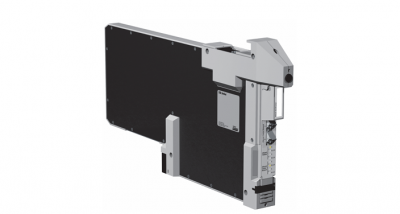
ZCP270